


Warehouses rarely fail visibly; operations continue, orders move, and systems still report stock. But beneath that surface, small inefficiencies quietly compound into significant financial leakage.
The real problem isn’t disruption, its undetected loss. In most operations, leaders believe they have control.
In reality, they are operating on delayed data, fragmented systems, and assumptions that no longer reflect physical inventory movement. This is the true nature of warehouse inefficiency, not breakdown, but misalignment between system truth and ground reality.
The Scale of the Problem: What Inefficiency Actually Costs
The financial impact of inefficiency is not theoretical, it is measurable, and in many cases, underestimated.
- The Warehouse Education and Research Council reports an average inventory shrinkage rate of 0.2% of inventory value
- Anything above 0.46% signals serious operational issues, while world-class operations stay below 0.2%
But shrinkage is only part of the story.
- Globally, inventory distortion (out-of-stocks + overstocks) costs retailers $1.73 trillion annually (~6.5% of global sales)
- Even a 1% error rate in a $10 million warehouse = $100,000+ direct loss, excluding operational inefficiencies
These numbers highlight a deeper issue: Warehouse inefficiency is not a cost center, it is a profit erosion system.

Where the Hidden Costs Actually Exist
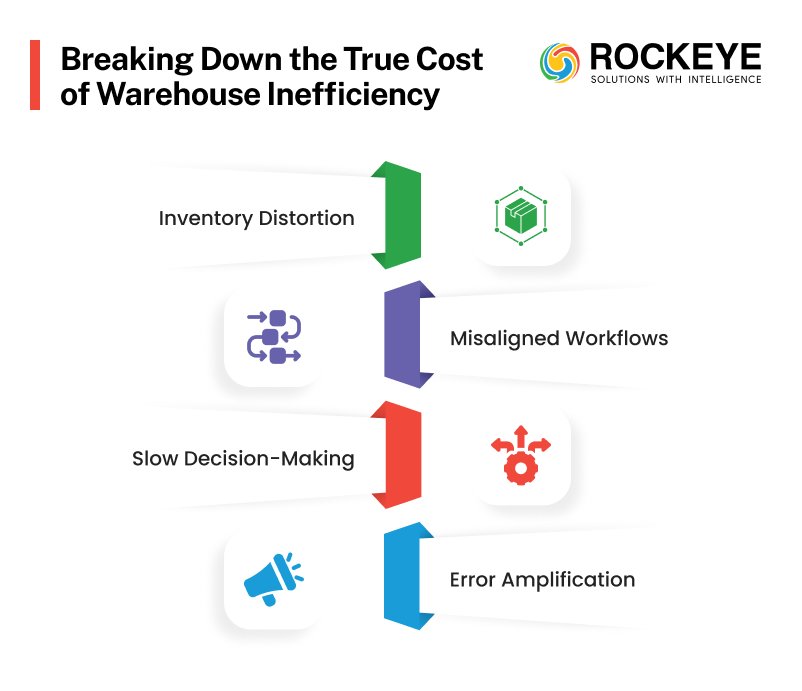
Most organizations track visible costs: labor, rent, transport. But the hidden costs of logistics operations exist in areas that are harder to measure:
Inventory Distortion (Ghost Stock & Overstocking)
The system shows stock. Physical inventory doesn’t match.
It leads to:
- Missed orders
- Excess procurement
- Working capital lock-in
Idle Labor & Misaligned Workflows
Unoptimized picking routes, manual validations, and delays reduce warehouse productivity, yet these effects are not immediately visible in reports.
Delayed Decision-Making
Without real-time insights, decisions are based on outdated data; creating cascading inefficiencies across procurement and fulfillment.
Error Amplification Across the Supply Chain
A small warehouse error doesn’t stay local, it expands into supply chain inefficiency, affecting delivery timelines, customer satisfaction, and cost structures.
Also read: From Manual CFR to RegTech: Automating Downstream Oil Compliance in Malaysia
Why Traditional Warehouse Management Fails
Most warehouses are not underperforming because of a lack of effort, but because of structural limitations in their systems.
The Core Gaps:
- Fragmented tools instead of a unified warehouse management system
- Manual reconciliation processes are prone to human error
- Lack of real-time synchronization between inventory and movement
- Static reporting instead of live operational intelligence
This is where traditional systems fall short. Even with basic WMS software, many operations remain reactive instead of predictive.
Reframing the Problem: Inefficiency is a Control Failure
Warehouse inefficiency is not just about processes.
It is about the lack of control over three critical layers:
- Inventory accuracy
- Movement validation
- Operational synchronization
When these layers are disconnected, inefficiencies don’t just occur, they compound silently.
What Efficient Warehousing Actually Looks Like
A high-performing warehouse is not defined by speed alone, but by precision and predictability.
Key Characteristics:
- Near real-time inventory accuracy
- Synchronized inbound, storage, and outbound flows
- Automated validation of movements
- Data-driven decision-making at every level
This is where modern warehouse management systems evolve from tools into control systems.
Also read: Why Indonesian Manufacturers Need ICCS And Not Just Traditional Manufacturing ERP Systems
How to Overcome Warehouse Inefficiency (Strategic Approach)
To truly address inefficiency, organizations must move beyond patch fixes.
1. Establish Real-Time Inventory Visibility
Eliminate discrepancies between the system and physical stock by continuously tracking them.
2. Automate Movement Validation
Ensure every inbound, internal transfer, and outbound movement is system-verified.
3. Optimize Workflow & Resource Allocation
Improve warehouse productivity by reducing idle time, redundant movements, and manual interventions.
4. Integrate Data Across Operations
Break silos between the warehouse, procurement, and distribution to eliminate inventory management problems.
5. Shift from Reactive to Predictive Operations
Leverage analytics to anticipate demand, reduce overstocking, and improve planning accuracy.
How ROCKEYE Eliminates Warehouse Inefficiency
In modern operations, efficiency cannot be achieved through isolated tools.
It requires a unified system that connects inventory, movement, and decision-making into a single control layer.
ROCKEYE’s warehouse inventory management solution is built to address exactly this challenge.
Unified Inventory Intelligence (Eliminating Distortion)
ROCKEYE provides real-time synchronization between physical stock and system data, eliminating ghost stock, shrinkage, and discrepancies.
Impact:
- Improved inventory accuracy
- Reduced working capital lock-in
- Strong foundation for warehouse operational cost reduction
Automated Workflow & Movement Control (Driving Productivity)
Every movement: receiving, picking, packing, dispatch is system-validated and optimized.
Impact:
- Higher warehouse productivity
- Reduced manual errors
- Faster order fulfillment cycles
Real-Time Decision Layer (Reducing Inefficiency)
ROCKEYE transforms warehouse operations from static reporting to live operational intelligence.
Impact:
- Faster, data-driven decisions
- Reduced delays and bottlenecks
- Lower supply chain inefficiency
Integrated WMS Capabilities (End-to-End Control)
Unlike traditional WMS software, ROCKEYE acts as a connected system across inventory, workflows, and enterprise operations.
Impact:
- Elimination of siloed data
- Consistent operational visibility
- Scalable warehouse management
The Cost of Inaction
Warehouse inefficiency does not remain constant, it compounds.
Without a control system:
- Shrinkage increases gradually
- Operational costs rise unnoticed
- Inventory inaccuracies multiply
- Customer experience declines
Over time, these inefficiencies can outweigh even major capital investments.
Conclusion: From Hidden Costs to Controlled Operations
Warehouse inefficiency is not just an operational issue, it is a strategic risk.
In a landscape where margins are tightening and customer expectations are rising, organizations cannot afford blind spots inside their warehouses.
The shift is clear:
From reactive warehouse management → to real-time operational control. With the right system in place, warehouses evolve from cost centers into precision-driven, profit-protecting assets.
FAQs
1. What are the hidden costs of warehouse inefficiency?
The hidden costs of warehouse inefficiency go beyond visible expenses like labor and storage. They include inventory shrinkage, ghost stock, delayed order fulfillment, excess carrying costs, and poor space utilization. These inefficiencies silently reduce margins and increase overall warehouse operational costs, often without immediate detection.
2. Why is warehouse inefficiency a growing problem for businesses in Indonesia?
In Indonesia, rapid ecommerce growth, fragmented logistics networks, and multi-location warehousing have increased operational complexity. Many businesses still rely on manual processes or disconnected systems, leading to rising supply chain inefficiency, inventory mismatches, and higher fulfillment costs.
3. How does poor warehouse layout increase operational costs?
An inefficient warehouse layout leads to longer picking routes, congestion, and increased handling time. It reduces warehouse productivity, increases labor dependency, and slows down order processing. Over time, these inefficiencies translate into higher per-order costs and reduced throughput.
4. What are the main signs of an inefficient warehouse operation?
Common signs include frequent stock discrepancies, delayed order fulfillment, excess or obsolete inventory, high return rates, and reliance on manual reconciliation. These indicators point to deeper inventory management problems and a lack of real-time visibility across operations.
5. How does warehouse inefficiency affect Ecommerce businesses in Indonesia?
For ecommerce businesses in Indonesia, warehouse inefficiency directly impacts delivery speed, order accuracy, and customer satisfaction. Delays, stock-outs, and incorrect shipments can lead to lost sales and reduced customer trust in highly competitive digital marketplaces.
6. What is the financial impact of overstocking and understocking in Indonesia’s warehouses?
Overstocking ties up working capital and increases storage costs, while understocking leads to missed sales and emergency procurement expenses. In Indonesia’s dynamic market, both issues contribute significantly to hidden costs in logistics operations, reducing profitability and operational efficiency.