


Nobody tells you this part.
They tell you to find your market. Build your team. Get your pricing right. Earn your first loyal customers.
But nobody tells you what happens the morning you open your third location, in a different city, maybe a different island, and realize the thing holding your entire business together is your own phone number.
Jakarta to Surabaya, Penang to Melaka, growth is happening. But the systems? Still running on WhatsApp messages, gut feel, and a spreadsheet only you truly understand.
It works in one location, but how about when you are scaling at 10? The manual and old lagged system failed, turning to survival mode and leakages. And business dashboard software is the ultimate tool you can have to make operational work.
The Truth About Multi-location Growth in This Region
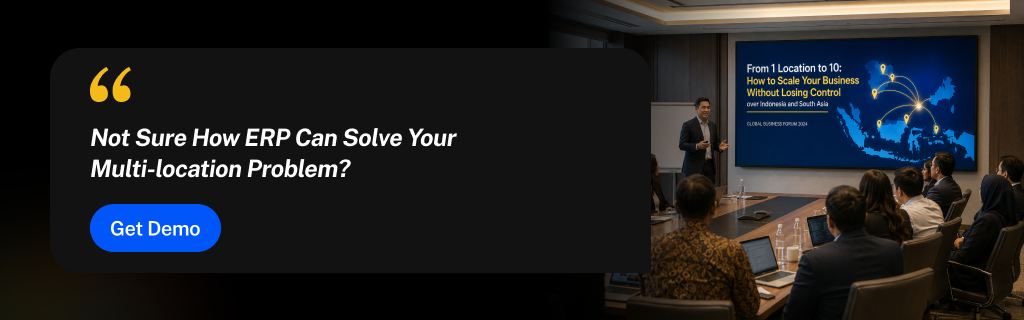
Businesses across Indonesia and South Asia are growing fast. The middle class is expanding. Consumer demand is rising. Franchise models are booming in F&B, retail, supply chain, education, healthcare, and beyond.
But here’s what most leaders discover around location three or four, which is always at the worst possible time. Growth doesn’t simplify your problems. It triggers more and compounds over time. Every operational gap you ignored at one location gets compounded at five. Every workaround your team builds becomes a liability at ten. The manager who “just knows” how to handle things in Bandung can’t also be in Bahru.
The businesses scaling well across this region aren’t smarter. They’re better-connected. Their data talks to their decisions with better business dashboard software. Their locations talk to each other. Their systems grow as fast as their ambitions do.
That’s not luck. That’s a strong infrastructure they built.
What You Actually Need Before Location Three
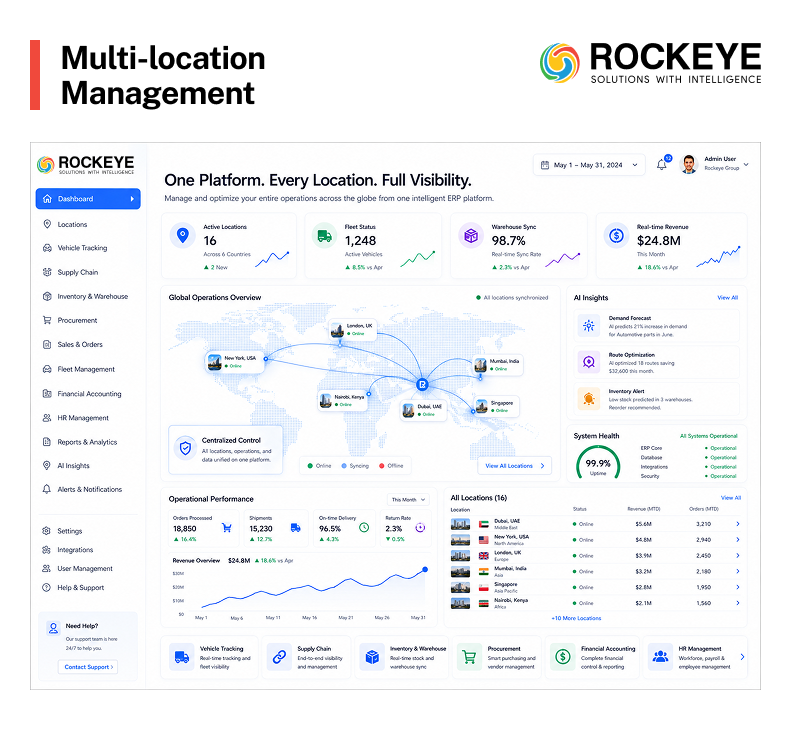
When your business spans multiple cities or countries, you need one thing above all else: a single version of reality, a multi-vendor marketplace. One system every location feeds into, reports from, and operates within.
Real-time Visibility
No more waiting for the weekly manager call to find out whether your Surabaya outlet is actually profitable.
Connected Operations
No more reconciling three versions of the same inventory data across WhatsApp threads.
Data-led Decisions
No more decisions dressed up as intuition when they’re really just guesses made on incomplete information.
Scalable Processes
Systems that grow as fast as your ambitions, built for location ten before you open location four.
Also Read – Manage Your Factory from Phone
The 4 Things ERP Actually Fixes
1. Your Operations Stop Depending on One Person’s Memory
Right now, someone on your team knows something critical that exists only in their head. That’s manageable at one location. It’s a serious risk at ten, especially when your locations are hours apart by flight.
Business process automation, built into modern ERP, standardizes how things get done across every location. Procurement approvals, inventory reorders, financial reconciliation, expense reporting, automated, consistent, no longer dependent on whether the right person remembered to send the right message at the right time.
Your best processes stop being local secrets. They become company-wide standards.
2. Your Inventory Stops Bleeding Money Quietly
Overstocked in one city and out of stock in another? This is one of the most expensive problems in multi-location retail and F&B businesses across the region, and one of the most invisible.
ROCKEYE ERP gives you visibility across your entire supply chain, from moving stock intelligently to reducing carrying costs. Stop losing customers because the product they came for was sitting in the wrong warehouse three cities away.
3. Managing Your People Actually Becomes Manageable
Here’s what surprises growing leaders: workforce complexity grows faster than headcount does.
More locations mean more schedules, more payroll cycles, and more compliance requirements across different provincial or state regulations. Workforce management software built into ERP centralizes all of it, scheduling, time tracking, HR records, and compliance documentation, so your people operations run as smoothly at location ten as they did at location one.
For businesses operating across multiple provinces in Indonesia or multiple states in India, this alone is worth the investment.
4. You Get a Real-time Pulse on the Whole Business
The leaders who scale with confidence aren’t naturally calmer people. They’re just people who can actually see what’s happening.
ERP gives you live dashboards and performance metrics across every location, so you catch a cash flow issue at your Cebu branch before it becomes a problem at your board meeting. So you spot which location is outperforming and ask why. So you lead on data, not on hope.
This is how our client solved logistical delays and fragmented efficiency with a real-time dashboard that helped it to gain 95% Inventory accuracy.
Also Read – The Hidden Cost of Warehouse Inefficiency
A Word on Franchise Growth Specifically
Franchise models are exploding across Indonesia, Malaysia, and multiple locations in food, education, healthcare, and services. And the leaders driving that growth are learning something quickly.
Franchise management software isn’t a nice-to-have. It’s the difference between a franchise that grows with consistency and one that fragments into ten slightly different businesses wearing the same logo.
Franchisees need operational clarity. Customers expect the same experience in Medan as they get in Jakarta. And you, as the franchisor, need the visibility and control to enforce standards without being on a plane every other week.
ERP is a business dashboard software designed for multi-location and franchise operations, gives you exactly that.
The Question Every Leader Asks
“Do we really need this now?”
Here’s the better question: What is not having this system costing us right now?
Count the hours your managers spend reconciling data that should reconcile itself. Count the decisions made on incomplete information. Count the customers who had a different experience at Location 6 than they did at Location 2, and didn’t come back.
That number isn’t small. And it compounds every time you open a new location.
The businesses that implement ERP before they desperately need it don’t just operate better. They grow with confidence because their systems are built for where they’re going, not just where they are today.
Take the Step Now
You’ve already done the hard part. You’ve validated the idea, built the team, and earned the right to grow. Now get a business dashboard software, a complete solution, an ERP, that makes that growth sustainable.
ROCKEYE ERP solutions are built for businesses exactly at this stage, companies that have outgrown their startup tools but are still building toward enterprise scale. Companies are expanding across cities, provinces, and borders. Companies that need real-time visibility, connected operations, and the confidence that comes from actually knowing what’s happening everywhere at once.
You don’t need to have everything figured out today. But the next location you open should run on a system that’s already ready for the one after that.
Talk to one of our advisors. Map where your current systems are breaking down. Build the foundation now, before growth makes it harder.
FAQs
When is the right time for a growing business to implement an ERP system?
Before you feel like you desperately need it, which usually means before location three, once operational chaos becomes your daily default, implementation gets harder and more expensive. Build the foundation early.
Is ERP only for large enterprises?
Not at all. ROCKEYE offers ERP solutions built specifically for mid-market and growing businesses across Southeast Asia and South Asia. You don’t need an enterprise headcount to benefit from connected, automated operations.
How long does implementation typically take?
For most mid-market businesses in this region, three to nine months, depending on complexity and how clearly you’ve defined your requirements. Starting with a focused scope and the right local implementation partner makes a significant difference.
Can ERP work across different regulatory environments, like multiple provinces or countries?
Yes. ROCKEYE ERP is built to handle multi-jurisdiction compliance, including local tax regulations, labor laws, and reporting requirements across Indonesia, India, and other markets in the region.