


Most ERP vendors will confidently tell you: “Yes, absolutely.”
But if you ask CFOs who’ve actually implemented one, the answer is more complicated.
Some say ERP transformed their business in weeks. Others say it took years just to recover implementation costs.
So what’s the truth?
Can an ERP really deliver ROI in 90 days, or is that just marketing noise?
Let’s break it down with real-world logic, recent research, and what actually drives ERP return on investment today.
The Myth vs Reality of “90-Day ERP ROI”
The idea of a 90-day ROI usually comes from cloud-first ERP systems promising fast deployment and immediate value. And yes, modern systems have changed the game.
But ERP is not a plug-and-play tool like accounting software. It touches:
- Finance
- Inventory
- Procurement
- Operations
- Assets
- Reporting
That means ROI doesn’t come from installation; it comes from adoption and process transformation.
Where ERP Actually Creates ROI (Fast)
Let’s talk about real ERP business benefits, not theoretical ones. ERP pays back fastest when it removes friction in daily operations. The biggest value drivers are:
1. Labor Cost Reduction (Immediate Impact)
Manual work is expensive. Data entry, reconciliation, approvals, and reporting eat up hours daily.
ERP eliminates:
- Spreadsheet duplication
- Manual stock tracking
- Email-based approvals
- Repetitive reporting
This is where ERP cost savings start showing up within weeks, not months.
2. Inventory & Asset Optimization
One of the fastest ROI drivers is better control over assets and stock. With smart asset tracking, businesses can:
- Reduce lost/misplaced equipment
- Improve utilization rates
- Avoid overstocking
- Prevent stockouts
Even a 10–15% reduction in inventory waste can significantly improve cash flow.
3. Decision Speed (Hidden ROI)
ERP doesn’t just save money; it saves time. Instead of waiting days for reports, managers get:
- Real-time dashboards
- Unified data sources
- Instant financial visibility
Faster decisions = fewer mistakes = direct financial impact.
4. Operational Leak Plugging
Most companies don’t realize how much money leaks through:
- Untracked procurement
- Duplicate purchases
- Billing delays
- Human error
ERP systems reduce these leaks dramatically, which is a core part of ERP implementation benefits.
Also Read: Why Intelligent ERP is the Real Business Revolution
ERP Cost vs Value: The Part No One Talks About
Let’s be honest, ERP isn’t cheap. Depending on scale, ERP implementation cost can range from:
- $10,000/year for SMB cloud ERP
- $100K–$500K for mid-market systems
- $1M+ for enterprise deployments
But here’s the key insight:
- ERP doesn’t fail because it costs too much. It fails because companies don’t measure ROI correctly.
Most businesses calculate ROI like this:
- ROI = (Savings – Cost) / Cost
But they forget to include:
- Time saved per employee
- Reduced operational delays
- Error reduction
- Inventory efficiency
- Revenue acceleration
That’s why real ERP ROI often looks very different from initial projections.
ERP Software for Small Business: The Real Game Changer
For years, ERP was considered an enterprise-only tool. That’s no longer true. Today, ERP software for small businesses is one of the fastest-growing segments in digital transformation.
Why?
Because SMBs feel inefficiencies more sharply than enterprises. A small manufacturing or trading business typically struggles with:
- No real inventory visibility
- Manual billing systems
- Disconnected accounting tools
- No centralized reporting
This is where cloud ERP becomes a game-changer.
Cloud ERP Benefits That Drive Faster ROI
Modern systems are shifting rapidly toward cloud-first architecture. The biggest cloud ERP benefits include:
- Lower upfront cost — no heavy infrastructure investment required.
- Faster implementation — go live in weeks instead of months.
- Continuous updates — avoid costly upgrade cycles.
- Scalability — add users and modules without rebuilding systems.
- Remote accessibility — enable teams to work from anywhere.
Research shows cloud ERP can reduce total cost of ownership by 30–60% over time. That’s a major driver of accelerated ROI timelines.
ERP Implementation Benefits (That Actually Matter in Real Life)
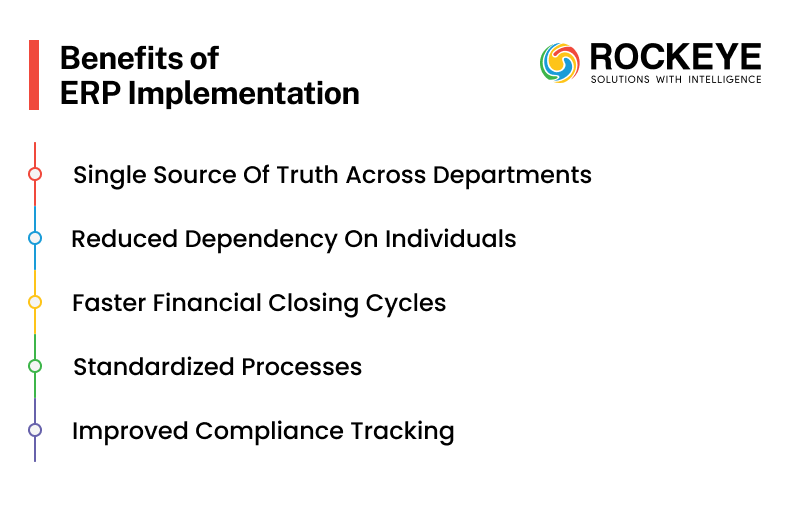
Let’s cut through the buzzwords. The real ERP implementation benefits are:
- Single source of truth across departments
- Reduced dependency on individuals
- Faster financial closing cycles
- Standardized processes
- Improved compliance tracking
And most importantly: ERP turns reactive businesses into proactive businesses. That shift alone can be worth more than any cost-saving metric.
So, Can ERP Actually Pay for Itself in 90 Days?
Here’s the honest answer:
YES, but only under specific conditions.
ERP can deliver 90-day ROI when:
- You start with high-impact modules (inventory, finance, procurement)
- You eliminate manual processes immediately
- Adoption is high from day one
- Data migration is clean
- Leadership enforces usage discipline
But for most companies, ERP delivers early value in 30–90 days, and full ROI in 12–24 months. The difference is between “System installed” vs “System fully adopted.”
Where Most ERP Projects Fail (And Waste ROI Potential)
Based on industry patterns, ERP failures usually come from:
- Over-customization
- Poor training
- Weak change management
- Lack of leadership involvement
- Trying to replace everything at once
This is why many businesses never realize full ERP return on investment.
How ROCKEYE Changes the ROI Equation
This is where modern ERP platforms like ROCKEYE come in. Unlike traditional systems that require long deployment cycles, ROCKEYE is designed around:
- Fast implementation cycles
- Modular rollout approach
- Real-time operational visibility
- Integrated financial + asset + inventory control
- Built-in intelligence for decision support
The goal is simple: Reduce time-to-value, not just software deployment time. That directly improves both ERP cost savings and ROI realization speed. Instead of waiting months to “see value,” businesses start seeing:
- Inventory clarity within weeks
- Reduced manual reconciliation almost immediately
- Better asset utilization from day one
- Faster reporting cycles
This is what modern ERP should look like.

ERP ROI Reality Check
Let’s summarize the truth:
- ERP is NOT a quick hack
- ERP IS a transformation system
- ROI depends on execution, not software alone
- Cloud ERP significantly improves speed-to-value
- SMBs often see faster relative gains than enterprises
- And most importantly: ERP doesn’t just return money, it returns control.
Final Thought
So, does ERP pay for itself in 90 days? Sometimes yes, but only when it is implemented with clarity, discipline, and focus on real operational pain points. For most businesses, the real win is not 90-day ROI. It’s about building a system where decisions are faster, errors are lower, operations are fully visible, and growth becomes scalable.
And that is exactly where modern ERP platforms like ROCKEYE redefine the game.
Frequently Asked Questions
1. Can an ERP really deliver ROI in 90 days?
Yes, but usually only when businesses implement high-impact modules first, eliminate manual processes quickly, and ensure strong user adoption from day one. For most companies, meaningful ROI starts within 3 months, while full ROI is typically achieved in 12–24 months.
2. What are the biggest factors that drive ERP ROI?
The biggest ROI drivers include reduced manual work, improved inventory control, faster reporting, lower operational errors, and better decision-making through real-time visibility.
3. Why do some ERP projects fail to generate expected ROI?
ERP projects often fail due to over-customization, poor employee training, weak change management, low leadership involvement, and trying to automate everything at once instead of taking a phased approach.
4. Is cloud ERP better for small and medium businesses?
Yes. Cloud ERP offers lower upfront costs, faster deployment, scalability, automatic updates, and remote accessibility, making it especially valuable for SMBs looking for quicker returns and operational efficiency.
5. How does ROCKEYE help businesses achieve faster ERP ROI?
ROCKEYE focuses on rapid implementation, modular deployment, real-time operational visibility, and integrated financial, asset, and inventory management, helping businesses reduce inefficiencies and start seeing value within weeks.