


Oil and gas operators are navigating complex distribution networks, regulatory requirements, and volatile market conditions. For C-suite executives, the stakes are high: operational inefficiencies, margin leakage, or unplanned downtime can directly impact profitability and competitive positioning.
Prescriptive analytics in oil and gas enables leaders to move beyond reactive decision-making and predictive forecasts, delivering actionable recommendations that drive measurable outcomes across terminals, depots, and retail outlets.
This blog explores how prescriptive analytics empowers fuel networks, improves sales and distribution in oil and gas, enhances predictive maintenance of pipelines, and drives overall business growth with data-backed decisions.
Also read: 7 Essential Features of Modern Terminal Management Systems in Oil and Gas
The Current Challenges in Oil & Gas Operations
Global oil and gas operators face several recurring challenges that affect margins, efficiency, and risk compliance:
- Revenue leakage across distribution networks: Manual reconciliation, delayed reporting, and inconsistent pricing lead to undetected losses at terminals and retail stations.
- Operational downtime: Equipment failures, unplanned maintenance, and inefficient scheduling can disrupt production and delivery.
- Complex sales & distribution logistics: Coordinating multiple depots, terminals, and retail outlets in different geographies requires precise planning and visibility.
- Data silos: Oil and gas data analytics is often fragmented across production, transportation, and retail functions, preventing a holistic view of operations.
Organizations that fail to address these challenges often experience reduced margins, missed revenue opportunities, and compliance risks.

Understanding Prescriptive Analytics in Oil & Gas
While predictive analytics on oil pipelines and production forecasts have become standard, prescriptive analytics takes the next step. Unlike predictive models that indicate what might happen, prescriptive analytics provides actionable recommendations: the best course of action based on current and historical data.
For example, a refinery or fuel terminal can leverage prescriptive analytics to:
- Determine optimal inventory levels at each depot or outlet.
- Adjust fuel pricing in real-time to protect margins.
- Schedule predictive maintenance for pipelines and equipment to avoid costly downtime.
- Optimize dispatch routes and fleet utilization across multiple locations.
By combining historical data, real-time sensor inputs, and advanced algorithms, prescriptive analytics empowers oil and gas leaders to make data-backed decisions on oil and gas operations that directly impact profitability.
Analytics-driven Oil Production: From Insights to Action
Analytics-driven oil production is about using operational data to improve efficiency, reduce waste, and boost output. Prescriptive analytics helps identify patterns and anomalies in production, enabling operators to:
- Predict equipment failures before they occur.
- Optimize crude blending and refinery throughput.
- Reduce unplanned shutdowns and maintenance costs.
- Align production schedules with fluctuating market demand.
The result is a more responsive, resilient, and profitable operation.
Key Benefits of Smart Fuel Networks Analytics
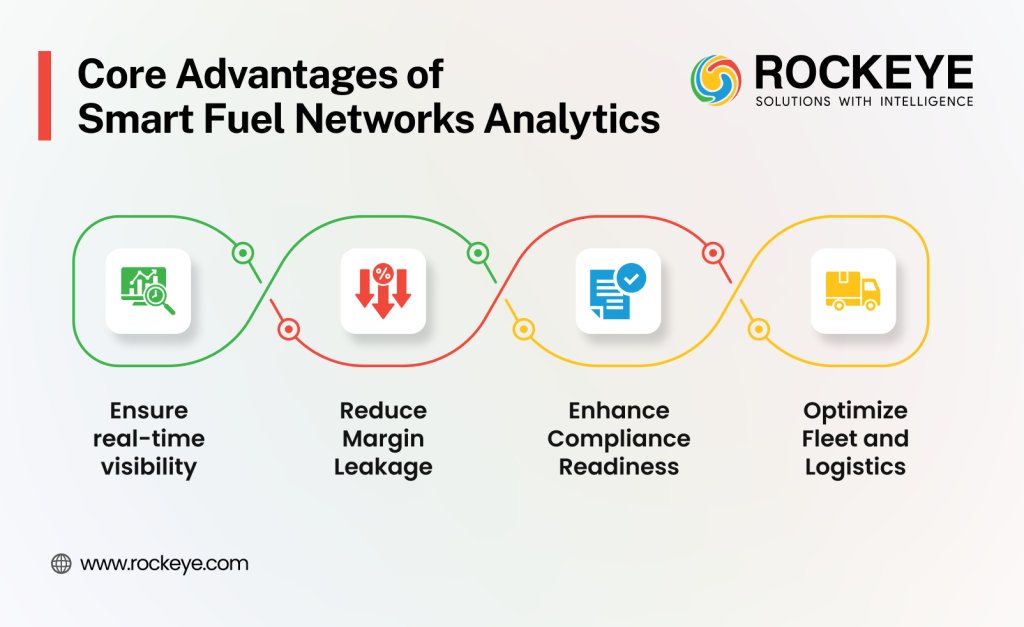
Modern fuel networks are highly interconnected, involving terminals, depots, retail stations, and transport fleets. Smart fuel networks analytics enables operators to:
- Ensure real-time visibility: Centralized dashboards track fuel inventory, deliveries, and sales across all locations.
- Reduce margin leakage: Pre-dispatch checks and automated reconciliation prevent unaccounted losses.
- Enhance compliance and audit readiness: Full traceability ensures regulatory compliance across geographies.
- Optimize fleet and logistics: Data-driven route planning and predictive maintenance reduce fuel and operational costs.
Operators leveraging these analytics solutions can achieve measurable improvements, such as up to 25% reduction in terminal losses within the first quarter, based on industry benchmarks.
Integrating Prescriptive Analytics in Sales & Distribution in Oil & Gas
Sales and distribution in oil and gas are complex, involving multiple stakeholders, contracts, and fluctuating prices. Prescriptive analytics solutions for oil and gas can transform these operations by:
- Automating margin checks across customer orders.
- Recommending pricing adjustments based on market conditions, FX rates, and contractual obligations.
- Prioritizing high-margin transactions while minimizing exposure to underperforming outlets.
- Streamlining reconciliation processes, reducing human error, and improving throughput.
By integrating prescriptive analytics into sales and distribution processes, companies gain real-time operational intelligence that drives profitability and efficiency.
Predictive Maintenance for Pipelines and Equipment
Pipeline failures or equipment downtime can cost millions in lost revenue and regulatory fines. Predictive maintenance of oil pipelines involves monitoring equipment conditions and forecasting potential failures before they happen. Prescriptive analytics enhances this approach by:
- Suggesting the most effective maintenance schedule.
- Identifying high-risk segments or equipment.
- Optimizing spare parts inventory to prevent bottlenecks.
- Reducing unplanned shutdowns and operational disruptions.
This approach shifts maintenance from reactive to proactive, translating into tangible savings and operational stability.
How ROCKEYE Supports Prescriptive Analytics in Oil & Gas
At ROCKEYE, we understand the unique challenges of global fuel networks. Our Oil & Gas Downstream Suite leverages prescriptive analytics to ensure operational efficiency, margin protection, and compliance across all terminals and retail outlets.
Here’s how we can help:
- Unified Commercial Control: Our DCCS platform integrates inventory, sales, and financial data to give you a single source of truth.
- Margin Governance: Instantly identify pricing leaks and optimize transactions to maximize profitability.
- Predictive & Prescriptive Insights: Leverage data-driven recommendations for inventory planning, pipeline maintenance, and dispatch optimization.
- Real-Time Monitoring: Access dashboards with live data from terminals, depots, and retail stations for timely decision-making.
- Global and Local Expertise: Tailored solutions for specific geographies such as Indonesia, Malaysia, Kenya, and the UAE ensure practical, measurable outcomes.
By implementing ROCKEYE, operators can expect reduced revenue leakage, faster throughput, and improved compliance, all while making data-backed decisions on oil and gas operations.
Implementing Prescriptive Analytics: Best Practices
To maximize the value of prescriptive analytics in oil and gas:
- Integrate data sources: Consolidate operational, sales, and financial data for a complete picture.
- Adopt a phased approach: Start with high-impact areas such as terminals or pipelines before expanding to retail networks.
- Leverage AI and ML models: Combine historical data with real-time inputs for predictive and prescriptive insights.
- Continuously monitor and optimize: Regularly refine models based on new data and evolving market conditions.
Organizations that follow these practices achieve better ROI, faster decision-making, and improved operational resilience.
Must read: How Leading Oil Companies Automate Pricing & Margin Control with Next-gen Commercial Systems
Case Example: Maximizing Terminal Efficiency in Southeast Asia
Consider a fuel distributor operating across multiple terminals in Malaysia. By deploying a prescriptive analytics solution:
- Pre-dispatch margin checks identified underperforming outlets.
- Optimized inventory allocations reduced overstocking by 20%.
- Predictive maintenance schedules cut pipeline downtime by 15%.
- Real-time dashboards enabled immediate corrective actions for pricing and delivery discrepancies.
The outcome: improved margin control, reduced losses, and a more agile network, demonstrating the practical value of prescriptive analytics solutions for oil and gas.

Conclusion
In an increasingly competitive oil and gas industry, operators cannot rely solely on intuition or historical trends. Prescriptive analytics in oil and gas equips businesses with the tools to make data-backed decisions, optimize operations, and protect margins across global fuel networks. From predictive maintenance of pipelines to smart fuel network analytics and advanced sales & distribution strategies, analytics-driven oil production ensures actionable insights translate into measurable business impact.
With ROCKEYE’s Oil & Gas Downstream Suite, companies can unlock the full potential of prescriptive analytics, transforming operational data into a strategic advantage. By embracing this approach, your business can reduce losses, increase throughput, and maintain industry-leading compliance, all while making every decision count.
FAQs
What is prescriptive analytics in oil and gas?
Prescriptive analytics goes beyond predicting outcomes. It provides actionable recommendations based on historical, operational, and real-time data, helping operators optimize inventory, maintenance, pricing, and dispatch decisions.
How does predictive maintenance of oil pipelines work?
Sensors and monitoring tools collect equipment data. Predictive models analyze this information to forecast potential failures, while prescriptive analytics recommends the most efficient maintenance actions to prevent downtime.
Can prescriptive analytics improve sales & distribution in oil and gas?
Yes. It automates margin checks, optimizes pricing, prioritizes high-value transactions, and reduces errors in reconciliation, improving both profitability and operational efficiency.
What are the benefits of smart fuel network analytics?
Benefits include real-time inventory visibility, margin protection, audit compliance, optimized logistics, and improved throughput—all of which directly contribute to higher profitability.
How can ROCKEYE help with oil & gas data analytics?
ROCKEYE’s DCCS platform integrates operations, sales, and financials to deliver prescriptive insights, optimize margins, prevent revenue leakage, and enable data-backed decisions in oil and gas operations globally.