


Artificial Intelligence is everywhere. It’s in boardroom conversations, product roadmaps, investor decks, and every second LinkedIn post. But for many businesses, AI still feels like a powerful idea that hasn’t fully translated into practical results.
That’s because AI on its own doesn’t create transformation. Real transformation happens when intelligence is embedded into the systems that run the business.
And that’s exactly why Intelligent ERP is becoming the real business revolution, not AI as a standalone tool, but AI as an operational advantage.
AI Buzz vs. Real Business Impact
There’s a major gap between what AI promises and what businesses actually experience.
Many organizations invest in AI initiatives expecting immediate breakthroughs, only to face confusion when results don’t match the hype. The issue is not that AI doesn’t work; it’s that AI adoption often lacks structure.
Here’s what “AI buzz” typically looks like:
- Running isolated AI pilots with no scalability plan
- Buying tools that don’t integrate with existing systems
- Building dashboards that show data but don’t guide decisions
- Collecting data without a clear operational use case
Meanwhile, real business impact looks very different:
- Forecasting inventory more accurately
- Reducing revenue leakage
- Improving cash flow predictability
- Automating reporting and compliance tasks
- Preventing operational bottlenecks before they happen
The truth is simple: AI delivers value only when it improves execution.
And execution doesn’t happen in scattered tools. It happens inside the system that connects every department, the ERP.

Why ERP Is the Backbone of AI Adoption
If AI is the brain, Cloud-based ERP is the nervous system.
ERP is where a business stores its operational reality: procurement, inventory, sales, finance, invoicing, production, logistics, vendor management, reporting, and more. It’s the central platform where workflows are executed, and business decisions are recorded.
That’s why ERP has become the foundation for AI adoption. Because AI needs three things to deliver real results:
1. Clean and connected data
AI cannot generate accurate predictions from disconnected spreadsheets and departmental silos. ERP creates centralized and structured data that AI can actually learn from.
2. Process visibility
AI works best when it understands how workflows move through the organization. ERP provides process visibility across departments.
3. A system to take action
Even the best AI insights are useless if they don’t translate into real action. ERP is where the procurement management system operates, approvals happen, payments happen, and reporting happens. That’s where intelligence must live.
In short: AI without ERP is just intelligence without execution.
Must read: Design Before Deployment: The Missing Principle in ERP-Led Operations
How Intelligence Inside ERP Transforms Decision-Making
Traditional ERP systems are excellent at one thing: recording transactions. They capture what happened: orders placed, invoices generated, stock moved, and payments made.
But modern businesses need more than history. They need foresight.
That’s where Intelligent ERP changes the game.
Instead of asking, “What happened last month?” leaders can start asking:
- What will demand look like next month?
- Where will cash flow tighten?
- Which suppliers are causing delays?
- Which products are slow-moving and hurting margins?
- What operational risks are building up silently?
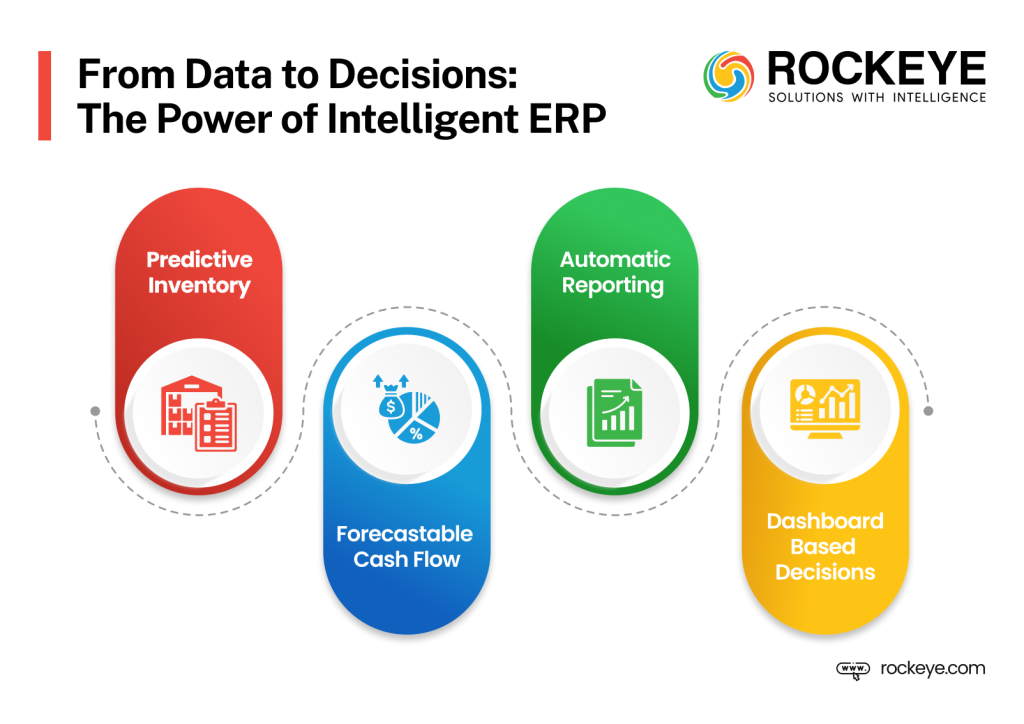
An Intelligent ERP doesn’t just store data. It interprets it, predicts outcomes, and recommends actions.
Inventory Becomes Predictive
In many companies, inventory decisions are still based on guesswork. Procurement teams reorder based on instinct, incomplete reports, or outdated trends.
When intelligence is built into ERP, inventory becomes data-driven. AI can detect patterns, anticipate demand shifts, and recommend reorder quantities based on real consumption history.
The result:
- Fewer stockouts
- Reduced overbuying
- Improved procurement planning
- Lower holding costs
Cash Flow Becomes Forecastable
Cash flow problems rarely appear suddenly. They build up quietly, delayed receivables, unplanned expenses, rising payables, and poor visibility.
Intelligent ERP systems can predict cash positions using invoice schedules, payment cycles, customer behavior, and vendor obligations.
The result:
- Stronger working capital planning
- Fewer liquidity surprises
- Better budgeting accuracy
- Improved financial control
Reporting Becomes Automatic
One of the biggest operational inefficiencies in most organizations is reporting. Teams spend hours pulling data from multiple sources, consolidating spreadsheets, verifying numbers, and formatting reports.
With intelligence inside ERP, reporting becomes automated and consistent. The system can generate real-time reports for management, compliance, finance, and operations without manual effort.
The result:
- Reduced admin workload
- Fewer reporting errors
- Faster decision cycles
- Improved audit readiness
Dashboards Become Decision Systems
Most dashboards are passive. They show KPIs, charts, and numbers, but don’t explain what’s wrong or what to do next.
Intelligent dashboards do more. They highlight anomalies, detect unusual trends, and trigger predictive alerts such as:
- Stock levels dropping faster than expected
- Sudden spikes in spending
- Receivables aging beyond normal patterns
- Declining order fulfillment rates
The result:
- Faster response times
- Fewer operational disruptions
- Proactive management instead of reactive firefighting
This is the true revolution: businesses stop reacting to problems and start preventing them.
Also read: Real-time ERP Visibility Across Kenyan Fuel Depots: The Missing Link in Supply Stability
Rockeye’s Approach to Intelligent ERP
At ROCKEYE, the vision is clear: ERP should not be a system that records operations. It should be a system that improves them.
ROCKEYE ERP is designed to help businesses move beyond manual processes and outdated reporting by enabling intelligence where it matters most inside the workflows teams use every day.
One Ecosystem, Not Disconnected Tools
ROCKEYE connects core business functions such as inventory, finance, operations, and reporting into one integrated environment. This creates a single source of truth, ensuring that decisions are based on consistent and reliable data.
Intelligence Built for Real Workflows
ROCKEYE focuses on practical, business-ready intelligence, predictive forecasting, automated reporting, and actionable dashboards that support daily execution.
It’s not AI for the sake of AI. It’s intelligence designed to solve real operational challenges:
- forecasting demand and procurement needs
- predicting cash flow outcomes
- reducing reporting workload
- improving visibility and decision-making speed
Decision-Making That Happens in Real Time
With ROCKEYE’s smart dashboards, leaders don’t need to wait for monthly reports to identify issues. They can see risks early, act instantly, and optimize operations continuously.
Built for Scalable Business Growth
As businesses grow, complexity grows with them: more vendors, more inventory categories, more locations, more financial transactions.
ROCKEYE ERP supports scalability by making operations smarter, not heavier. Instead of adding more manual processes as the company expands, ROCKEYE enables automation and intelligence to keep growth efficient.
In a world where speed is a competitive advantage, ROCKEYE helps businesses stay ahead with structured operations and intelligent execution.
Conclusion
The AI revolution isn’t about chatbots, buzzwords, or expensive experiments. It’s about building smarter businesses that can operate with speed, accuracy, and control.
That’s why Intelligent ERP is the real revolution. Because ERP is where business happens, and intelligence embedded inside ERP is what turns data into decisions, and decisions into growth.
The future belongs to organizations that stop chasing AI hype and start applying intelligence where it delivers real outcomes.