


Growth changes everything.
The warehouse system that worked perfectly with one location often becomes the biggest operational challenge once you expand to three, five, or ten warehouses.
At first, the problems seem manageable. A few stock transfers here. A couple of spreadsheets there. Some calls between warehouse managers to verify inventory.
Then complexity starts multiplying.
Sales teams promise unavailable products. Procurement orders stock that already exists elsewhere. Warehouse staff spend hours tracking inventory across locations. Leadership waits days to get answers that should take seconds.
The result?
- Higher inventory costs
- Slower operations
- Frustrated customers
- Decisions made with incomplete information
Many businesses assume these challenges are simply part of managing multiple warehouses.
They are not. They are often symptoms of one underlying problem:
A lack of centralized visibility. And the cost is far greater than most organizations realize.
The Hidden Problem Most Multi-Warehouse Businesses Face
Ask a warehouse manager how much stock they have. Ask a procurement manager the same question. Then ask the sales team. In many organizations, you will receive three different answers.
That may sound surprising, but inventory accuracy remains a major challenge across industries. Studies show average inventory accuracy sits at only 83%, while 58% of businesses operate below 80% accuracy.
Now imagine that problem spread across multiple warehouses. A stock discrepancy in one location becomes a purchasing mistake in another. A delayed update creates an unnecessary transfer. A misplaced SKU triggers an emergency replenishment order. Each issue may seem small individually.
Together, they create operational chaos. Without centralized visibility, businesses are essentially managing warehouses in isolation while trying to operate as a unified organization. And that disconnect becomes expensive very quickly.
When Inventory Exists but Nobody Can Find It
One of the most frustrating situations in warehouse management is being out of stock while simultaneously carrying excess inventory. It happens more often than many businesses admit. A customer order arrives. Warehouse A does not have the required stock.
The procurement team places a replenishment order. Three days later, someone discovers the inventory was sitting in Warehouse C all along. The product existed. The visibility did not.
What Happens Next?
The consequences start piling up:
- Duplicate purchase orders
- Excess safety stock
- Higher carrying costs
- Increased warehouse congestion
- Cash trapped in inventory
Every warehouse starts carrying more inventory “just in case.” Every manager builds their own buffer. And every location becomes less efficient.
The Real Problem Is Not Inventory
Most businesses assume they need more stock. What they actually need is better visibility.
Without centralized inventory data, warehouses operate like separate businesses rather than a connected network. Poor inventory tracking creates exactly these imbalances, leading to both overstocking and stockouts across the supply chain.
The Operational Delays Nobody Measures
Most organizations track delivery delays. Few track decision delays. Yet decision delays often create larger operational bottlenecks than transportation issues.

A Typical Multi-Warehouse Scenario
A customer places an urgent order. To confirm availability, teams often need to:
- Contact multiple warehouse managers
- Verify stock manually
- Review inventory reports
- Check pending transfers
- Request approvals
What should take minutes takes hours. Sometimes days.
Why This Matters
Every delayed decision impacts:
- Customer response times
- Order fulfillment speed
- Procurement planning
- Inventory transfers
- Operational productivity
As warehouse networks grow, these delays multiply. And growth starts slowing down.
Recent industry reports show inefficient internal inventory movement and logistics processes continue to create substantial operational losses for retail businesses, locking up working capital and impacting sales opportunities.
Also read: The Hidden Cost of Warehouse Inefficiency and How to Overcome It
Why Inventory Discrepancies Directly Impact Revenue
Inventory errors rarely stay inside the warehouse. Eventually, they reach customers. Your system says a product is available. The warehouse says it is not. An order gets delayed. A shipment gets cancelled. A customer leaves.
Research shows inventory inaccuracies contribute significantly to lost sales, with stockouts and inventory distortions costing businesses substantial revenue every year.
sage.agency
The Ecommerce Impact Is Even Bigger
Industry estimates suggest global ecommerce companies lose between 3% and 5% of annual sales due to inventory discrepancies and stock visibility issues. Think about that for a moment.
A company generating millions in annual revenue could potentially lose 3-5% of sales simply because inventory information is not accurate. The challenge becomes even more severe when multiple warehouses are involved. A product may be available somewhere within the network.
But if teams cannot see it in real time, it might as well not exist. Customers do not care which warehouse has the inventory. They care whether you can fulfill the order.
The Leadership Bottleneck Nobody Plans For
Growth should create freedom. Instead, many growing businesses experience the opposite.
Leadership Becomes the System
Without centralized visibility, teams struggle to make decisions independently. Questions keep moving upward:
- Should inventory be transferred?
- Should stock be reordered?
- Which warehouse should fulfill the order?
- What caused the discrepancy?
Managers spend less time leading and more time chasing information.
The Cost of Decision Bottlenecks
Over time, this creates:
- Slower execution
- Reduced accountability
- Operational confusion
- Increased management overhead
- Delayed growth initiatives
The larger the warehouse network becomes, the worse the bottleneck gets.
Also Read: How Can the Right Warehouse Management Software Cut Operational Costs?
What Central Visibility Actually Delivers
Many organizations view visibility as a reporting feature. The reality is much bigger.
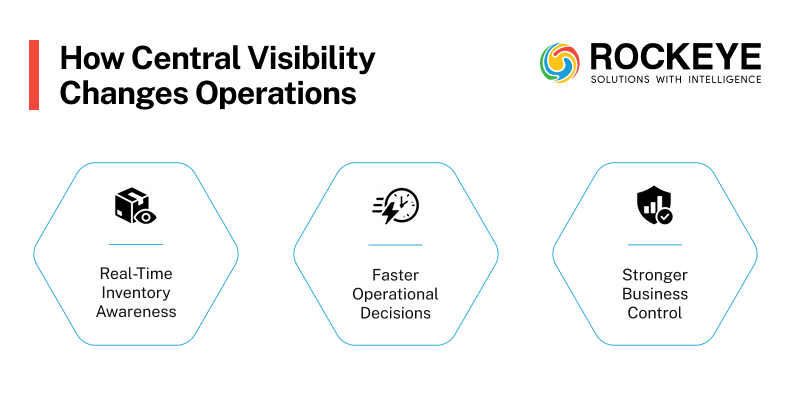
Real-Time Inventory Awareness
With warehouse inventory management software, teams know exactly:
- What inventory is available
- Where it is located
- How quickly it is moving
- When replenishment is required
Faster Operational Decisions
Instead of reacting to problems, teams can proactively:
- Rebalance stock
- Plan replenishments
- Prevent stockouts
- Optimize warehouse utilization
Stronger Business Control
When everyone works from the same data:
- Decisions become faster
- Inventory becomes leaner
- Operations become predictable
- Growth becomes scalable
That is the real value of centralized warehouse visibility.
How ROCKEYE Helps Businesses Regain Control
This is exactly where a centralized warehouse inventory management platform becomes critical.
ROCKEYE Warehouse Inventory Management Solution
ROCKEYE ERP helps businesses manage inventory across multiple warehouses from a single unified platform.
Instead of relying on disconnected systems and manual updates, organizations gain real-time visibility into:
- Inventory movement
- Stock levels
- Warehouse operations
- Replenishment activities
What Businesses Can Achieve with ROCKEYE
With centralized inventory tracking, businesses can:
- Monitor stock across multiple warehouse locations in real time
- Track inventory movement from receipt to dispatch
- Optimize warehouse utilization
- Reduce stock discrepancies and manual errors
- Improve replenishment planning
- Enable faster inventory transfers between locations
- Generate actionable operational insights through dashboards and reporting
The result is simple.
More visibility. Better decisions. Stronger operational control. And a warehouse network that scales with the business rather than slowing it down.
The Competitive Advantage of Inventory Accuracy
Inventory accuracy is not just an operational metric. It is a profitability metric. Organizations achieving near 99% inventory accuracy typically spend only around 5% of product costs on inventory-related expenses, significantly lower than businesses struggling with inventory discrepancies.
Why Accuracy Changes Profitability
That difference compounds over time:
- Lower carrying costs
- Fewer emergency purchases
- Reduced stockouts
- Higher customer satisfaction
- Better resource utilization
When multiplied across multiple warehouses, the financial impact becomes substantial. The organizations that scale successfully are rarely the ones carrying the most inventory. They are the ones who understand exactly where their inventory is.
Final Thoughts
Running multiple warehouses without centralized visibility creates more than operational inefficiencies.
It creates uncertainty.
- Uncertainty about inventory
- Uncertainty about decisions
- Uncertainty about growth
At first, the consequences appear as small discrepancies and occasional delays. Over time, they evolve into duplicate stock, rising costs, decision bottlenecks, and lost revenue.
The solution is not more spreadsheets. It is not more phone calls. And it certainly is not more inventory.The solution is visibility.
Because when every warehouse operates from the same real-time information, inventory becomes easier to manage, decisions become faster, and growth becomes far more predictable.
The question is no longer whether your business can afford centralized warehouse visibility. It is whether it can afford to operate without it.
FAQs
What is centralized warehouse visibility?
Centralized warehouse visibility provides a real-time view of inventory, stock movement, warehouse operations, and fulfillment activities across all warehouse locations through a single platform. It enables teams to make faster and more accurate operational decisions.
Why do businesses struggle with inventory accuracy across multiple warehouses?
Inventory inaccuracies often result from manual processes, disconnected systems, delayed updates, inconsistent stock transfers, and a lack of real-time synchronization between warehouse locations. These issues become more difficult to manage as warehouse networks expand.
How does poor inventory visibility affect customer experience?
Poor visibility can lead to stockouts, delayed shipments, cancelled orders, and inaccurate delivery commitments. Customers may lose trust when inventory information does not match actual stock availability.
Can warehouse inventory management software reduce duplicate stock?
Yes. By providing real-time visibility across all locations, warehouse inventory management software helps businesses identify available inventory before placing new purchase orders, reducing unnecessary stock duplication and carrying costs.
How does ROCKEYE help manage multiple warehouses?
ROCKEYE provides centralized inventory tracking, real-time stock visibility, warehouse monitoring, inventory movement tracking, reporting dashboards, and replenishment management capabilities that help businesses improve operational efficiency and inventory accuracy across multiple warehouse locations.