


The palm oil industry in Indonesia and Malaysia operates in a highly competitive environment where people are the driving force behind business success. Whether you’re a business owner, HR manager, operations leader, or IT decision-maker, managing employees efficiently can quickly become challenging as your organisation grows.
This is where a palm oil HRMS becomes more than just another software solution; it becomes a strategic business asset. Instead of relying on disconnected spreadsheets, manual paperwork, and multiple systems, companies can centralise HR operations, improve workforce visibility, and make better decisions with accurate data.
In this article, we’ll explore why a dedicated HRMS is becoming essential for palm oil companies, the challenges it solves, the features to look for, and how choosing the right platform can help organisations across Indonesia and Malaysia build a more efficient workforce.
Why Do Palm Oil Companies Need a Dedicated Palm Oil HRMS?
Every industry has unique workforce requirements, and the palm oil sector is no exception. Generic HR software often provides basic employee management capabilities, but it rarely addresses industry-specific operational complexities.
A dedicated HRMS is designed to support the way palm oil companies actually operate. It enables HR teams to manage employee records, attendance, payroll, leave, compliance, performance, and workforce reporting from a single platform.
More importantly, it creates consistency across departments while reducing the manual effort involved in day-to-day HR administration. When HR processes become more streamlined, business leaders can focus less on administrative work and more on growing the business.

What HR Challenges Do Palm Oil Companies Commonly Face?
As organisations expand, HR teams often find themselves juggling multiple responsibilities simultaneously.
Some of the most common challenges include:
- Maintaining accurate employee records across different locations.
- Managing attendance without manual reconciliation.
- Processing payroll accurately and on time.
- Tracking leave balances efficiently.
- Keeping employee documents organised.
- Ensuring compliance with labour regulations.
- Reducing repetitive manual data entry.
- Generating reports for management quickly.
Individually, these challenges may seem manageable. Together, they can consume significant time, increase operational costs, and create unnecessary administrative pressure.
Did You Know?
According to data from the Indonesian Palm Oil Association, the palm oil sector directly and indirectly supports over 20 million workers in Indonesia alone, contributing up to 17% of the nation’s GDP.
Managing a labor force of this magnitude requires robust enterprise technology built specifically for regional scale.
How Does a Dedicated HRMS Simplify Everyday HR Operations?
A specialised HRMS brings all HR functions into one integrated ecosystem. Instead of switching between spreadsheets, emails, paper documents, and standalone payroll software, HR teams work from a single source of truth.
1. Employee Information Management
Every employee’s information is stored securely in one location, making it easier to update records, retrieve documents, and monitor employment history whenever needed.
2. Attendance Management
Modern HRMS platforms automate attendance tracking, reducing manual calculations while improving transparency for both HR teams and employees.
3. Payroll Processing
Payroll often consumes a considerable amount of HR’s monthly workload. Automation helps reduce calculation errors, speeds up payroll processing, and ensures employees are paid accurately.
4. Leave Management
Employees can submit leave requests digitally while managers approve them through automated workflows. This eliminates lengthy email chains and improves visibility across departments.
5. Performance Management
Managers can conduct structured performance evaluations, monitor employee development, and maintain consistent appraisal processes.
Don’t Miss: 9 HR Tasks You Should Be Automating Today
Why Is Manual HR Management Becoming Unsustainable?
Many growing companies still rely on spreadsheets because they appear simple and inexpensive. However, as employee numbers increase, manual HR processes become increasingly difficult to manage.
1. Manual Systems Create Errors
Repeated manual data entry increases the likelihood of:
- Duplicate Employee Records
- Payroll Mistakes
- Missing Attendance Information
- Incorrect Leave Balances
- Lost Documentation
Even small inaccuracies can affect employee satisfaction and create unnecessary administrative work.
2. Limited Reporting
Business leaders need reliable data for workforce planning. Manual systems often require HR teams to spend hours compiling reports instead of analysing workforce trends.
3. Poor Visibility
Without a central HR platform, managers struggle to obtain real-time workforce information, making informed decision-making more difficult.
What Is the Difference Between Generic HR Software and a Dedicated Palm Oil HRMS?
Choosing software isn’t simply about buying an HR system. It’s about selecting one that aligns with your industry’s operational requirements.
| Feature | Generic HR Software | Dedicated Palm Oil HRMS |
| Employee management | Basic | Industry-focused workflows |
| Attendance | Standard tracking | Flexible attendance management across multiple business locations |
| Payroll | Generic payroll processing | Configurable payroll for complex workforce structures |
| Compliance | Limited flexibility | Better support for regional HR compliance requirements |
| Reporting | Standard reports | Workforce-specific operational insights |
| Scalability | Moderate | Designed for growing palm oil businesses |
| Integration | Limited | Easier integration with broader business systems |
A dedicated solution provides greater flexibility while reducing the need for manual workarounds.
Must Read: How HRMS software can increase productivity and thereby boost profitability in any organization?
How Can Better HR Data Improve Business Decisions?
HR data isn’t just useful for HR teams. It supports better decisions across the entire organisation. With accurate workforce information, management can:
- Understand Workforce Trends
- Improve Manpower Planning
- Monitor Attendance Patterns
- Reduce Payroll Discrepancies
- Track Employee Performance
- Support Compliance Initiatives
- Make Faster Business Decisions
Instead of reacting to problems after they occur, businesses can proactively manage their workforce using reliable information. This is one of the biggest advantages of implementing a dedicated palm oil HRMS.

What Features Should You Look for in a Palm Oil HRMS?
Not every HRMS delivers the same value. When evaluating software, look beyond the basic HR functions. A strong solution should include:
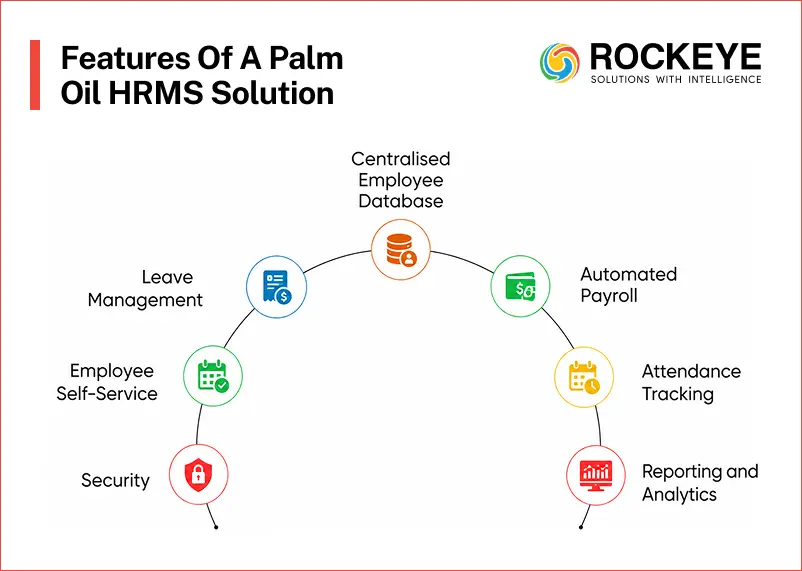
1. Centralised Employee Database
A secure repository for employee information, contracts, documents, and employment history.
2. Automated Payroll
Accurate payroll processing with configurable rules and minimal manual intervention.
3. Attendance Tracking
Digital attendance management with real-time visibility.
4. Leave Management
Simple employee leave applications with automated approval workflows.
5. Employee Self-Service
Allow employees to access payslips, update personal information, and submit HR requests independently.
6. Reporting and Analytics
Generate meaningful reports that support strategic decision-making.
7. Security
Protect sensitive employee information through role-based access and secure data management.
Why Does Employee Experience Matter More Than Ever?
Today’s employees expect convenience. They don’t want to fill out paper forms, wait for manual approvals, or contact HR for every small request. An HRMS improves employee experience by offering:
- Faster HR Services
- Transparent Leave Balances
- Digital Document Access
- Self-service Capabilities
- Better Communication
- Faster Approvals
When HR becomes easier, employees spend less time dealing with administrative tasks and more time focusing on productive work. Satisfied employees often contribute to better organisational performance.
How Can the Right HRMS Support Long-Term Business Growth?
Business growth often brings additional HR complexity. More employees mean more payroll processing, more documentation, more approvals, and greater compliance responsibilities.
A scalable HRMS grows alongside the organisation. Rather than constantly introducing new spreadsheets or additional software, companies can manage expansion using one integrated platform.
This improves operational consistency while reducing administrative overhead. For businesses planning long-term growth in Indonesia and Malaysia, investing in the right HR technology today helps avoid operational bottlenecks tomorrow.
Why Consider ROCKEYE’s Palm Oil Software for HR Management?
After understanding the importance of a dedicated HRMS, the next step is selecting a solution built with the industry’s operational needs in mind.
ROCKEYE’s palm oil software combines HR management with broader enterprise capabilities, helping businesses centralise workforce information while improving operational visibility. Instead of relying on disconnected systems, organisations can manage HR processes through an integrated platform that supports efficiency, data accuracy, and informed decision-making.
For companies seeking long-term digital transformation, choosing software that aligns with business growth objectives can make a significant difference.
Conclusion
Managing HR manually becomes increasingly difficult as organisations grow. From employee records and payroll to attendance, leave, reporting, and compliance, every HR function requires accuracy, consistency, and efficiency.
A dedicated palm oil HRMS helps companies simplify HR operations, improve employee experience, reduce administrative workload, and make smarter business decisions based on real-time data.
For palm oil companies across Indonesia and Malaysia, investing in the right HR technology isn’t simply about automation; it’s about creating a stronger foundation for sustainable business growth. Solutions like ROCKEYE’s palm oil software provide businesses with an integrated approach to workforce management while supporting long-term operational excellence.
Frequently Asked Questions
Can HRMS software handle the workforce complexity of palm oil companies?
Yes, HRMS software can help palm oil companies manage workforce complexity by bringing employee information, attendance, payroll, leave, compliance records, and HR workflows into one central system.
As companies grow, managing employee-related information across multiple teams and locations becomes challenging. A dedicated HRMS provides better visibility, reduces administrative dependency, and helps HR teams maintain accurate records without relying on manual processes.
Is HRMS only useful for large palm oil companies?
No, HRMS is useful for both growing and established palm oil companies. Small and mid-sized businesses can use HRMS to create structured HR processes early, while larger organisations can use it to manage complex workforce requirements at scale.
Implementing HR technology early helps companies reduce manual work, improve accuracy, and build processes that support future growth.
How can palm oil companies reduce HR errors?
Palm oil companies can reduce HR errors by automating repetitive activities such as employee data management, attendance tracking, payroll calculations, and reporting.
A centralised HR system ensures that teams work with updated and consistent information. This reduces problems caused by duplicate records, incorrect calculations, missing documents, and manual data entry mistakes.
What problems can companies face without a digital HR system?
Without a digital HR system, companies may experience delays in HR processes, inaccurate reporting, difficulty accessing employee information, and increased administrative workload.
Common issues include:
Time-consuming manual approvals
Difficulty tracking employee records
Limited workforce insights
Increased dependency on spreadsheets
Higher chances of human errors
A digital HR system helps organisations create faster, more transparent, and more reliable HR operations.
How does HR automation improve employee experience?
HR automation improves employee experience by making everyday HR interactions faster and simpler.
Employees can access important information, submit requests, check updates, and complete HR-related activities without depending entirely on HR teams.
This creates greater transparency, improves communication, and allows employees to spend less time on administrative tasks.
What should businesses consider before investing in HR software?
Before investing in HR software, businesses should evaluate whether the solution can support their current requirements and future growth.
Important factors include:
Ease of Implementation
Scalability
Data Security
Reporting Capabilities
Integration Options
User Experience
Vendor Support
The right HR software should solve existing challenges while providing flexibility for changing business needs.
Why are spreadsheets not enough for modern HR management?
Spreadsheets can work for basic HR tracking, but they become difficult to manage as employee numbers and business complexity increase. Unlike spreadsheets, HR software provides automation, security controls, real-time updates, workflow management, and accurate reporting.
For businesses managing a growing workforce, moving from spreadsheets to an HRMS improves efficiency and reduces administrative burden.
How does HR technology support business growth in Indonesia and Malaysia?
HR technology supports business growth by helping companies manage employees more efficiently while improving operational visibility. For businesses in Indonesia and Malaysia, a digital HR solution helps organisations standardise HR processes, maintain accurate employee information, and make faster decisions using reliable workforce data.
As competition increases, companies with streamlined HR processes are better positioned to scale effectively.
What makes industry-specific HR software better than standard HR tools?
Industry-specific HR software is designed around the unique requirements of a particular sector. While standard HR tools provide general employee management features, industry-focused solutions offer better flexibility, workflows, and reporting capabilities suited to specific business environments.
For palm oil businesses, choosing the right palm oil HRMS can help improve workforce management by addressing industry-specific HR challenges more effectively.
How do I know if my company needs an HRMS upgrade?
A company may need an HRMS upgrade when existing HR processes become difficult to manage, require too much manual effort, or cannot provide accurate workforce insights.
Signs that indicate the need for an upgrade include:
HR teams spending too much time on administrative tasks
Frequent payroll or data errors
Delayed approvals
Difficulty generating reports
Limited employee self-service options
An HRMS upgrade helps businesses create more efficient and scalable HR operations