


If you’re evaluating ERP software for a palm oil business, you’ve probably asked yourself one important question: Should you invest in a generic ERP or choose software built specifically for your industry?
This debate around industry-specific ERP vs generic ERP has become more relevant than ever, especially for businesses in Indonesia and Malaysia, where operational complexity, regulatory expectations, and customer demands continue to grow.
At first glance, a generic ERP may seem like the practical choice. It promises flexibility, broad functionality, and support for multiple industries. But once you start adapting it to the unique workflows of the palm oil sector, things often become more complicated and more expensive.
An industry-focused ERP, on the other hand, is designed around the day-to-day realities of palm oil businesses. Instead of forcing your team to change the way they work, it supports the processes that matter most, improves visibility across operations, and reduces the need for endless customization.
In this article, we’ll break down the key differences, compare both approaches, and explain why industry-specific software consistently delivers better long-term value.
Industry-Specific ERP vs Generic ERP: Understanding the Real Difference
The discussion around industry-specific ERP vs generic ERP isn’t about which software is more powerful. It’s about which software is more relevant to your business.
A generic ERP is designed to serve companies across many industries. Manufacturing, retail, distribution, healthcare, and construction can all use the same platform with different configurations.
An industry-specific ERP is built with one industry in mind. Every feature, workflow, report, and dashboard is designed to solve challenges unique to that sector.
For palm oil companies, this means the software already understands industry requirements instead of relying on expensive custom development.
Think of it as buying a tailored suit rather than altering a standard one. Both may eventually fit, but one gets you there faster, costs less over time, and feels like it was made for you from the beginning.
Do You Know?
As per Gartner, 1 in 5 ERP implementations fail to deliver 70% of expected benefits, with customization and scope creep being primary cost drivers.
Palm Oil ERP Comparison: Generic ERP vs Industry-Specific ERP
A clear palm oil ERP comparison shows where industry-focused software creates value.
| Feature | Generic ERP | Palm Oil ERP |
| Industry workflows | Requires customization | Built specifically for palm oil operations |
| Implementation time | Often longer due to configuration | Faster because industry processes are already included |
| Reporting | Standard business reports | Industry-focused dashboards and analytics |
| Compliance support | Requires additional setup | Designed to align with industry reporting needs |
| Scalability | Flexible but highly configurable | Scales while maintaining industry best practices |
| User adoption | Longer learning curve | Familiar workflows improve adoption |
| Long-term maintenance | Higher customization costs | Lower dependency on custom development |
Although generic ERPs are highly capable, businesses often spend months or even years modifying them before they truly fit operational needs.
Why Generic ERP Often Falls Short
Many companies initially choose generic ERP because it appears to be the safer investment. Unfortunately, reality often looks different after implementation.
1. Too Much Customization
A generic ERP gives you a blank canvas. While that sounds flexible, every customization adds cost, increases project timelines, and makes future upgrades more complicated. Instead of using ready-made workflows, your business spends time recreating processes that already exist in industry-focused software.
2. Complex User Experience
When software tries to serve every industry, it naturally becomes more complicated. Employees frequently encounter features they never use while struggling to find the functions they actually need.
This often results in:
- Longer employee training
- Slower adoption
- More manual workarounds
- Increased dependency on IT teams
3. Higher Total Cost Over Time
The software license is only one part of ERP ownership. Businesses also need to consider:
- Custom development
- Ongoing maintenance
- Third-party integrations
- Future upgrades
- User training
These hidden costs can significantly increase the total investment.
Must Read: What is Palm Oil ERP Software? A Complete Guide for Mills & Refineries
Why Palm Oil ERP Delivers Better Business Value
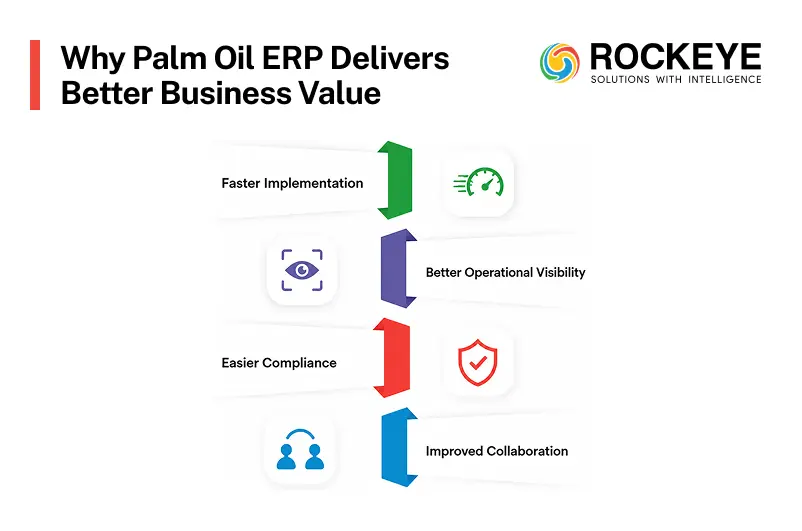
An ERP built specifically for the palm oil industry focuses on solving operational challenges instead of asking businesses to redesign their workflows. Here are some of the biggest advantages.
1. Faster Implementation
Because industry-specific modules are already available, implementation usually takes less time. Your team spends more time learning the system and less time defining requirements from scratch.
2. Better Operational Visibility
Decision-makers gain access to dashboards that actually matter. Instead of generic financial reports alone, they can monitor operational performance through meaningful industry metrics, enabling faster and more confident decisions.
3. Easier Compliance
Regulatory requirements continue to evolve across Indonesia and Malaysia. Industry-specific ERP solutions are typically designed with these reporting expectations in mind, reducing manual effort and improving reporting accuracy.
4. Improved Collaboration
Different departments often rely on separate systems or spreadsheets. A dedicated palm oil ERP connects teams through a single platform, making information easier to access and reducing communication gaps.
Signs Your Business Has Outgrown a Generic ERP
Not every company needs to replace its ERP immediately. However, these warning signs often indicate it’s time to consider an industry-specific solution.
- Your team relies heavily on spreadsheets.
- Reports require manual consolidation.
- Software updates break customized features.
- Employees complain that the ERP feels too complicated.
- You spend more on customization than innovation.
- Decision-making takes longer because information is scattered.
- Multiple departments use disconnected systems.
If several of these sound familiar, your ERP may be limiting growth rather than supporting it.

Choosing the Right ERP for Businesses in Indonesia and Malaysia
Companies across Indonesia and Malaysia operate in competitive markets where efficiency directly affects profitability. When evaluating ERP software, don’t focus only on feature lists.
Instead, ask practical questions:
Does it match your business processes?
Software should support how your business already operates instead of forcing unnecessary changes.
Can your employees learn it quickly?
A system that employees enjoy using often delivers better long-term ROI than one packed with unused features.
Will it grow with your business?
Choose software that can support future expansion without requiring major redevelopment every few years.
Does it provide industry-focused reporting?
The right ERP should generate meaningful insights without requiring countless custom reports.
These considerations make a significant difference during implementation and throughout the software’s lifecycle.
Beyond Features: Think About Long-Term ROI
Many ERP buying decisions focus heavily on upfront pricing. That’s understandable, but it rarely tells the full story. The real return on investment comes from:
- Reduced Manual Work
- Faster Reporting
- Better Operational Visibility
- Lower Customization Costs
- Easier Software Upgrades
- Improved Decision-making
- Higher Employee Productivity
When viewed over five to ten years, an industry-focused ERP often proves to be the more cost-effective investment. This is one reason the conversation around industry-specific ERP vs generic ERP has shifted from software functionality to long-term business outcomes.
Businesses increasingly recognize that software aligned with their industry helps reduce operational complexity while supporting sustainable growth.
How to Evaluate Palm Oil ERP Software
Before making a decision, create a checklist instead of comparing software based only on marketing materials. Look for an ERP that offers:
- Industry-ready Workflows
- Real-time Dashboards
- Strong Inventory Visibility
- Financial Management
- Supply Chain Integration
- Role-based Access Controls
- Easy Reporting and Analytics
- Scalable Architecture
- Reliable Implementation Support
The best ERP isn’t necessarily the one with the most features. It’s the one your team can use confidently every day while supporting business growth.
Why Many Businesses Choose Specialized Solutions Like ROCKEYE
As businesses expand, many discover that generic ERP systems require continuous customization to keep pace with operational demands.
This is where specialized platforms like ROCKEYE can offer an advantage. Designed specifically for the palm oil industry, ROCKEYE focuses on industry-relevant workflows, operational visibility, reporting, and scalability, rather than requiring extensive post-implementation modifications.
If you’re exploring purpose-built ERP software for palm oil businesses in Indonesia or Malaysia, you can see how our platform supports palm oil operations.
The goal isn’t simply to replace existing software; it’s to adopt a platform that better aligns with how your business operates today while supporting future growth.
Conclusion
Choosing between a generic ERP and a specialized solution isn’t simply a software decision; it’s a strategic business decision.
While generic ERP platforms offer flexibility across multiple industries, they often require significant customization before they truly fit the needs of palm oil businesses. In contrast, industry-focused solutions are built around established operational requirements, making implementation faster, reporting more meaningful, and long-term maintenance simpler.
As this industry-specific ERP vs generic ERP discussion continues to shape ERP buying decisions across Indonesia and Malaysia, more businesses are recognizing that software designed specifically for their industry delivers stronger operational efficiency, lower lifetime costs, and better business outcomes.
If your goal is to improve visibility, streamline operations, and support sustainable growth, an industry-specific palm oil ERP is often the smarter long-term investment.