
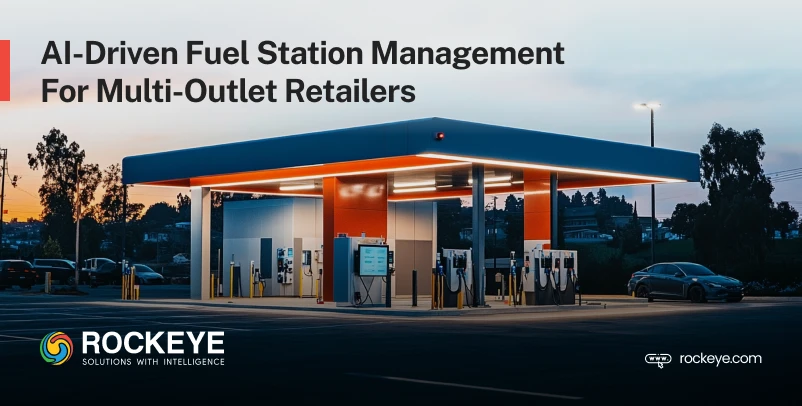
Fuel retail has entered a transformative phase. Rising operational costs, tightening margins, labour inefficiencies, and fluctuating consumer demand have reshaped the economics of fuel retailing across many regions. Multi-outlet retailers now face increasing pressure to run leaner operations while strengthening profitability and compliance.
This shift has accelerated the adoption of intelligent digital systems designed to optimise cost structures and deliver accurate, real-time decision-making. Among these technologies, AI-powered smart fuel station management has emerged as the most significant enabler of sustainable profitability and operational excellence.
Modern fuel networks require more than manual supervision or conventional POS tools. They need integrated platforms that combine AI, automation, advanced telemetry, predictive analytics, and centralised governance. This is where next-generation systems, such as a fuel station management system, smart fuel management system, and fuel station POS system become essential for retailers seeking scalable control across multiple locations.
This article explains how AI-powered automation helps multi-outlet fuel retailers minimise losses, optimise resources, enhance compliance, and improve gross margins.
Why Multi-Outlet Fuel Retailers Need AI Now More Than Ever
Multi-location operations face inherent challenges that increase financial risk. These include:
- Variations in pricing accuracy across stations
- Manual errors in pumping, billing, dispatch, and reconciliation
- Unrecorded losses from poor tank monitoring
- Inefficient workforce deployment
- Delays due to offline or non-integrated systems
- Excessive inventory holding due to inaccurate demand forecasting
These issues directly impact profitability. Traditional systems cannot offer the visibility, speed, or precision required to eliminate leakages and achieve consistent governance. Retailers need solutions that not only record transactions but also analyse them, predict deviations, and automate controls before losses occur.
An AI-enabled ecosystem that integrates fuel station management software, fuel inventory management system, and filling station management software provides that capability.
How AI-Powered Fuel Station Management Transforms Multi-Outlet Retail
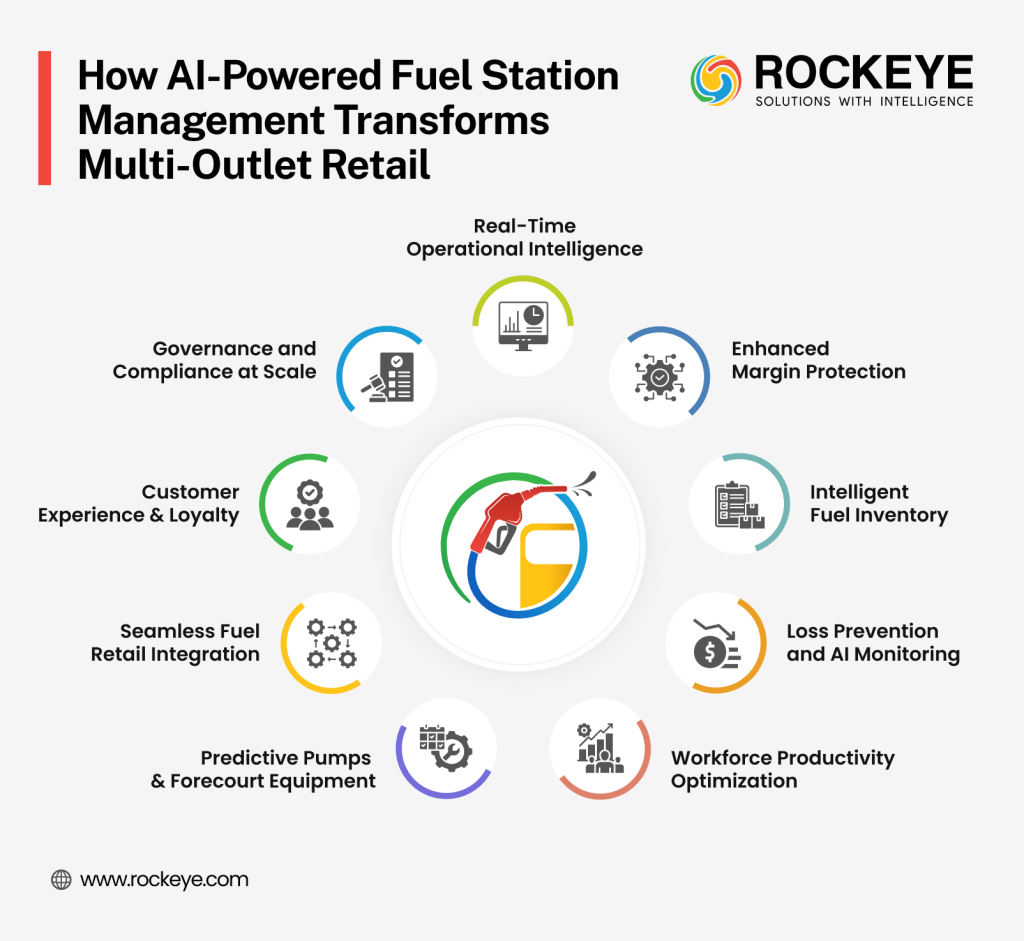
1. Real-Time Operational Intelligence for Every Outlet
AI-powered platforms consolidate data from pumps, tanks, forecourt devices, POS terminals, and back-office systems into a unified interface. This visibility enables retailers to:
- Monitor sales, pricing, volumes, and tank levels in real time.
- Detect anomalies such as sudden dips, unusual sales patterns, or variance between physical and expected stock.
- Standardise processes across all outlets.
Multi-outlet retailers gain control by making every station fully transparent. For example, the system can flag discrepancies between pump readings and POS billing within seconds, reducing untraceable losses.
This level of visibility is not possible with manual systems or traditional POS tools. AI transforms raw data into precise operational insights, strengthening governance and compliance across the network.
2. Enhanced Margin Protection Through Automated Controls
Profitability in fuel retail depends on precise, real-time margin management. Even minor discrepancies can escalate into significant financial leakage. AI-enabled fuel station POS system platforms help retailers:
- Apply dynamic pricing rules.
- Track margin performance across products and stations.
- Highlight low-performing outlets and under-recovered expenses.
- Automatically reconcile supplier invoices with actual delivered volumes.
Many retailers struggle with manual margin tracking, especially when operating numerous outlets. AI solves this by continuously analysing fluctuations in procurement costs, taxes, FX exposure, sales volumes, and dispensing accuracy.
Retailers can therefore lock in margin performance station by station, supported by central governance.
Must Read: Why Traditional ERPs Fail Fuel Downstream Operations – The Case for DCCS
3. Intelligent Fuel Inventory Planning and Replenishment
Fuel inventory is one of the highest cost centres for retail chains. Overstocking increases holding costs and reduces liquidity, while understocking leads to lost revenue.
A modern fuel inventory management system uses AI and predictive analytics to:
- Forecast demand based on historical data and upcoming trends.
- Calculate optimal reorder levels.
- Trigger automated purchase requests.
- Prevent runouts by detecting unusual consumption patterns.
For multi-outlet operations, consolidated inventory forecasting significantly reduces waste, dependency on manual measurement, and discrepancies between book stock and tank stock.
AI ensures each station holds the right quantity of fuel at the lowest possible carrying cost.
2025 Stat Fact
The Internet of Things in retail is already a multi‑billion‑dollar market, estimated at around 66 billion USD in 2024 and projected to grow at more than 20% annually as retailers accelerate investments in real-time analytics, automated inventory, and predictive maintenance.
4. Loss Prevention and Shrinkage Control with AI Monitoring
Fuel shrinkage arises from leakages, calibration errors, short deliveries, pilferage, or unrecorded dispensing. Conventional monitoring methods often discover losses too late.
AI-powered smart fuel management system platforms continuously track:
- Tank levels vs. expected stock
- Fuel movement patterns
- Delivery timestamps
- Pump metering irregularities
- Variances between inflow and outflow
Machine learning models detect anomalies and alert station managers immediately. Retailers can prevent losses before they become significant.
When integrated with a filling station management system, this solution provides automated reconciliation between tanker dispatch, receipt, and actual tank-level change, strengthening audit readiness and compliance.
5. Workforce Productivity Optimisation
Fuel stations depend heavily on manpower. Inefficient deployment increases cost and reduces customer service quality. AI tools help optimise:
- Shift planning
- Staffing based on footfall and sales patterns
- Task automation across billing, reporting, and reconciliation
- Employee performance monitoring
This reduces reliance on manual supervision while ensuring operational continuity across all locations. Retailers benefit from improved labour productivity, reduced overtime costs, and consistent service quality.
6. Predictive Maintenance for Pumps and Forecourt Equipment
Unexpected downtime disrupts operations, reduces sales, and increases customer dissatisfaction.
AI-enabled maintenance & service solution systems track equipment performance and forecast maintenance needs. This allows retailers to:
- Replace parts before they fail
- Reduce downtime
- Extend equipment life
- Minimise emergency repair costs
Predictive analytics ensures that pumps, ATG systems, POS devices, and critical forecourt equipment remain operational across all branches.
7. Seamless Integration Across All Fuel Retail Operations
Modern fuel station management software integrates all critical functions:
- Sales and billing
- Procurement
- Inventory
- Pricing
- Dispatch
- Reconciliation
- Financial reporting
For multi-outlet chains, this cohesiveness is essential. AI ensures uniformity in reporting, compliance, process flow, and audit readiness across all locations.
Retailers gain a centralised command centre capable of managing their entire network with high accuracy.
Also Read: Downstream Supply Chain Control – Real-time Visibility in Fuel Transport
8. Strengthened Customer Experience and Loyalty
AI influences customer experience in several ways:
- Dynamic pricing and loyalty programs
- Reduced waiting time through faster billing
- Accurate pump dispensing
- Personalised offers based on purchase history
- Seamless digital payment integration
A modern fuel retail POS supported by AI ensures accuracy, speed, and consistency, essential for high-footfall stations.
9. Governance and Compliance at Scale
Compliance failures carry financial and reputational risks. AI automates compliance-related tasks, including:
- Maintaining accurate logs
- Recording transactions for audits
- Validating deliveries
- Ensuring calibration consistency
- Maintaining digital trails
This strengthens governance, reduces manual intervention, and ensures multi-outlet networks operate with predictable accuracy.
How AI Enhances Profitability for Multi-Outlet Retail Chains
When AI is integrated across a fuel station management system, the financial impact becomes tangible. Key benefits include:
- Reduced operational expenditure
- Lower shrinkage and pilferage
- Higher throughput from faster operations
- Better liquidity through precise inventory planning
- Improved gross margins from accurate pricing and fuel management
- Enhanced compliance and audit readiness
AI turns fuel retailing from manual supervision into a data-driven, self-governing, highly controlled operation.
This is the modern standard for profitable fuel retailing.
Schedule a demo today to see your 2025 profitability projection.
Conclusion
Sustained profitability in fuel retail requires precision, governance, and automation across every outlet. AI-powered fuel station management transforms traditional operations into intelligent, self-optimising ecosystems. Multi-outlet retailers gain complete control over losses, margins, inventory, workforce productivity, compliance, and customer experience.
With rapidly evolving market conditions, adopting AI-driven tools such as a smart fill fuel management system or modern filling station management software is no longer optional. It is essential for retailers seeking consistent profitability and long-term competitive advantage.
FAQs
1. How can AI reduce operating costs in smart fuel stations?
AI reduces operating costs by automating tasks such as tank monitoring, pricing, reconciliation, and shift planning. It detects anomalies early, prevents losses, optimises staff deployment, and strengthens compliance. These improvements collectively minimise operational waste and reduce expenditure across multiple outlets.
2. What role does AI play in improving profitability for multi-outlet fuel retailers?
AI enhances profitability by improving margin control, reducing shrinkage, optimising inventory levels, and improving throughput. It enables real-time visibility across all outlets, helping retailers pinpoint inefficiencies and take corrective actions quickly. This ensures consistent profit performance across branches.
3. How does AI-based fuel monitoring help prevent losses and theft?
AI-based monitoring analyses tank levels, pump data, delivery volumes, and historical patterns to detect discrepancies instantly. It identifies leakages, meter tampering, short deliveries, abnormal consumption, and unrecorded dispensing. Early detection prevents revenue loss, protects assets, and strengthens audit trails.
4. What AI tools optimise fuel station operations and workforce productivity?
AI tools include automated shift planners, pump performance trackers, demand forecasting engines, dispatch automation modules, POS optimisation tools, and reconciliation engines. These tools reduce manual workloads, increase operational speed, and improve staff utilisation.
5. How does predictive analytics improve fuel station performance?
Predictive analytics anticipates demand, identifies potential equipment failures, optimises reordering cycles, and highlights risk areas before they escalate. Retailers can maintain optimal stock, prevent downtime, and plan resources efficiently. This leads to higher throughput and improved profitability.