


Walk through any large production facility in Indonesia or Malaysia, and everything may seem to be running smoothly, machines humming, workers busy, output moving. But beneath that surface efficiency, a silent drain is often at work.
It’s not a major breakdown or a catastrophic failure. It’s 2–3% raw material waste.
At first glance, that number feels insignificant. But for large production houses handling millions in raw material costs, this “small” percentage can quietly translate into millions in lost IDR or MYR every year. And the most concerning part? Most businesses don’t even realize how much they’re losing.
The Illusion of “Acceptable” Waste
In many factories, a small percentage of waste is considered normal, almost unavoidable. Teams account for it, budgets absorb it, and operations continue.
But here’s the reality: “That 2% isn’t just waste, it’s pure profit slipping away.”
Imagine this scenario:
- Annual raw material spend: MYR 100 million
- Waste level: 2%
- Annual loss: MYR 2 million
Now multiply that across multiple plants or years. What seemed negligible suddenly becomes a major financial leak. And because this loss is distributed across processes, it rarely triggers alarm bells.
Where the Loss Actually Happens
Raw material waste doesn’t usually come from one big mistake. It builds up through small inefficiencies across your operations.
1. Production Planning Gaps
When planning isn’t aligned with real-time demand or machine capacity, inefficiencies creep in.
- Overproduction leads to excess inventory
- Frequent changeovers increase material loss
- Poor scheduling creates idle time
Even a slight mismatch between planning and execution can ripple across the entire production cycle.
2. Inconsistent Quality Control
Defects are one of the most visible forms of waste, but they’re often underreported or discovered too late.
When quality checks are manual or delayed:
- Entire batches may need rework
- Raw materials are scrapped unnecessarily
- Customer returns increase operational costs
A small defect rate can quickly escalate into a large financial burden.
3. Lack of Real-time Visibility
Many production houses still rely on spreadsheets or disconnected systems. This creates a dangerous gap between what’s happening and what’s being reported.
Without real-time data:
- Material overuse goes unnoticed
- Variances are discovered too late
- Decision-making becomes reactive instead of proactive
In short, you can’t fix what you can’t see.
4. Inventory Mismanagement
Inventory is where a large portion of waste hides quietly.
- Overstocking leads to expired or obsolete materials
- Understocking causes rushed purchases and inefficiencies
- Poor tracking results in material mismatches
For many manufacturers, inventory alone ties up nearly half of their working capital, making even small inefficiencies extremely costly.
5. Machine Inefficiencies and Downtime
Machines don’t need to stop completely to create waste. Even minor inefficiencies can reduce output and increase material consumption.
- Frequent minor stoppages
- Suboptimal machine settings
- Lack of performance monitoring
These issues slowly erode productivity while increasing raw material usage.
Why Traditional Systems Can’t Fix This
Many businesses attempt to control waste using manual tracking, spreadsheets, or basic tools. While these methods may have worked in the past, they struggle to keep up with modern production complexity. The core issue is fragmentation. When your systems are disconnected:
- Production data doesn’t align with inventory
- Quality insights don’t reach planning teams
- Management decisions are based on outdated information
This creates blind spots, and blind spots are where waste thrives.
The Shift Toward Digital Control
To truly reduce waste, manufacturers need more than better discipline. They need visibility, integration, and control. This is where a modern production management software or production management solution becomes essential. Instead of treating each department separately, these systems connect your entire production ecosystem into a single, unified platform.
What a Modern Production Management Solution Actually Does
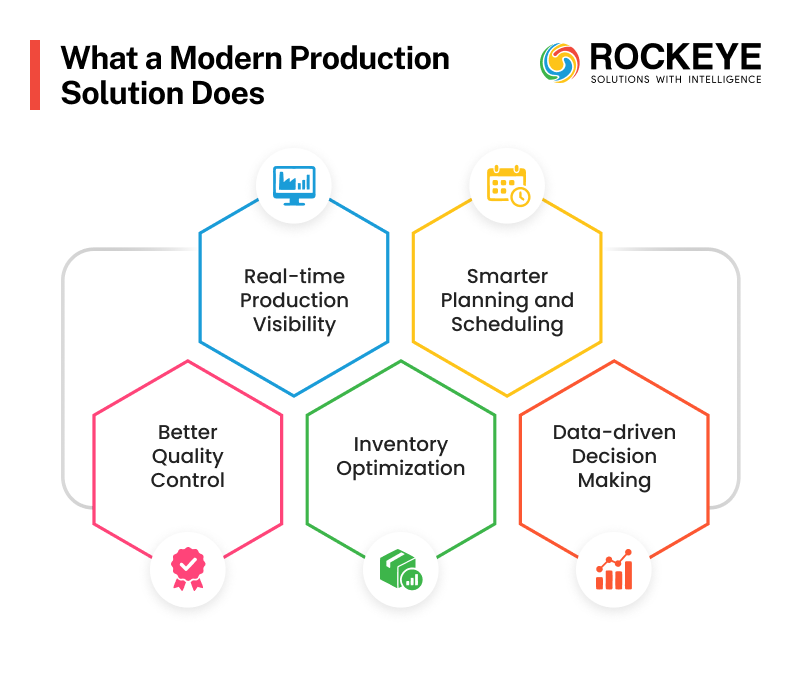
A well-designed system, especially when powered by a cloud-based ERP, transforms how factories operate on a day-to-day basis. Here’s how it changes the game:
Real-time Production Visibility
You gain instant insights into what’s happening on the shop floor, allowing you to track raw material usage at every stage of production. Instead of discovering inefficiencies later, you can identify waste as it occurs and take immediate action. At the same time, real-time monitoring of machine performance ensures that any issues are quickly detected, helping maintain efficiency and reduce unnecessary losses.
Smarter Planning and Scheduling
Planning becomes dynamic instead of static, allowing production to adapt in real time to changing conditions. This enables you to align output with actual demand, optimize machine utilization for maximum efficiency, and reduce unnecessary changeovers that often lead to wasted time and materials.
Better Quality Control
Quality is no longer reactive; it becomes proactive, allowing issues to be addressed before they escalate. By detecting defects early in the process, businesses can significantly reduce scrap and rework while maintaining consistent output standards across production.
Inventory Optimization
You move from guesswork to precision, enabling tighter control over inventory and materials. This allows you to maintain optimal stock levels, reduce excess inventory that ties up capital, and improve material traceability across every stage of production.
Data-driven Decision Making
Instead of relying on assumptions, decisions are backed by real data, giving you a clear and accurate view of your operations. With precise cost tracking, detailed waste analytics and reporting, and predictive insights, businesses can continuously identify improvement opportunities and drive ongoing efficiency gains.
Turning Waste Into Measurable Profit
When manufacturers implement a robust production management solution, the results are not just operational; they are financial.
Even modest improvements can lead to:
- Noticeable reduction in raw material consumption
- Lower defect rates and rework costs
- Improved production efficiency
- Better utilization of working capital
What was once “acceptable waste” becomes a clear opportunity for profit recovery.
A Practical Approach: ROCKEYE’s Production Management Software
For businesses in Indonesia and Malaysia looking to tackle this challenge, solutions like ROCKEYE’s production management software offer a focused and practical approach.
Rather than adding complexity, the platform is designed to simplify and unify operations.
It helps manufacturers:
- Gain end-to-end visibility across production
- Track raw material usage in real time
- Improve planning accuracy
- Integrate quality control into daily workflows
- Manage multiple plants through a single cloud-based system
The goal is straightforward: reduce hidden waste and turn operational data into measurable business value.
Why Cloud-based ERP Matters in Indonesia & Malaysia
Manufacturing in Southeast Asia is evolving rapidly. Businesses are scaling, supply chains are becoming more complex, and competition is intensifying.
A cloud-based ERP provides the flexibility needed to keep up. It enables:
- Centralized control across multiple locations
- Real-time collaboration between teams
- Faster implementation without heavy infrastructure
- Scalability as operations grow
For large production houses, this is no longer optional; it’s becoming the standard.
The Risk of Ignoring the Problem
It is easy to delay change when operations appear stable, but hidden waste does not remain constant; it gradually grows over time. Without the right systems in place, costs continue to rise, inefficiencies compound across processes, and profit margins slowly shrink. Over time, competitors who operate more efficiently begin to gain a clear advantage. The biggest risk is not sudden disruption, but a slow and often unnoticed decline in performance and profitability.
Conclusion: The 2% That Changes Everything
That small percentage of waste you’ve been overlooking holds the key to higher profitability, greater efficiency, and stronger competitiveness. The opportunity is already within your operations; you just need the visibility to unlock it. The question is no longer whether waste exists; it’s whether you’re equipped to eliminate it.
FAQs
1. How much raw material waste is normal in manufacturing?
Most manufacturers operate with 1–3% waste, but even 1% can result in significant financial loss at scale. Reducing it can directly improve profitability.
2. How does production management software help reduce waste?
It provides real-time visibility, improves planning accuracy, automates quality control, and optimizes inventory, helping identify and eliminate inefficiencies quickly.
3. What is a production management solution?
A production management solution is a system that integrates planning, execution, quality, and inventory processes to streamline manufacturing operations.
4. Is cloud-based ERP suitable for large production houses?
Yes. A cloud-based ERP is scalable, supports multi-location operations, and reduces infrastructure costs, making it ideal for large manufacturers.
5. How quickly can waste reduction be achieved?
Many businesses start seeing measurable improvements within a few months, with significant results typically within 6–12 months.
6. Which industries benefit the most from these solutions?
Industries with high material usage and large-scale production benefit the most, including:
Textiles
FMCG
Food processing
Chemicals
Heavy manufacturing
7. Why is reducing waste important beyond cost savings?
Reducing waste improves sustainability, lowers environmental impact, and helps businesses meet regulatory and customer expectations.