
Fuel margins in Kenya operate under constant pressure. Price regulation, currency movement, logistics costs, and intense competition leave little room for error. Yet many fuel networks continue to lose margin not because of market forces, but due to what happens between the depot gate and the fuel station tank.
Depot variance is one of the most underestimated threats to fuel margins Kenya-wide. It does not appear suddenly or dramatically. It accumulates quietly through measurement gaps, delayed reconciliation, and weak visibility across terminals, transport, and retail outlets. Over time, this silent erosion directly impacts oil marketing company margins, Kenya-wide.
For leadership teams responsible for profitability, depot variance is no longer an operational issue. It is a strategic margin risk.
Understanding Depot Variance in the Kenyan Fuel Context
Depot variance refers to the difference between fuel quantities released from depots and the quantities eventually recorded at downstream points such as stations or bulk customers. In Kenya, where fuel pricing is tightly regulated and margins are capped, even small variances can materially affect profitability.
Depot variance Kenya-wide often emerges from a combination of factors. These include meter inaccuracies, temperature variations, manual documentation, transport losses, delayed posting, and reconciliation gaps between depot systems and station-level records.
Unlike outright theft, depot variance is difficult to detect without structured controls. It hides within acceptable tolerance levels until cumulative losses become significant.
Why Depot Variance Has a Direct Effect on Fuel Margins in Kenya
Fuel margins Kenya-wide are already thin due to regulatory pricing controls and competitive retail environments. When depot variance occurs, it directly reduces recoverable volume without any opportunity for price correction.
The effect of depot variance on OMC margins is severe because losses occur after procurement costs have already been incurred. Every litre lost through variance represents pure margin erosion.
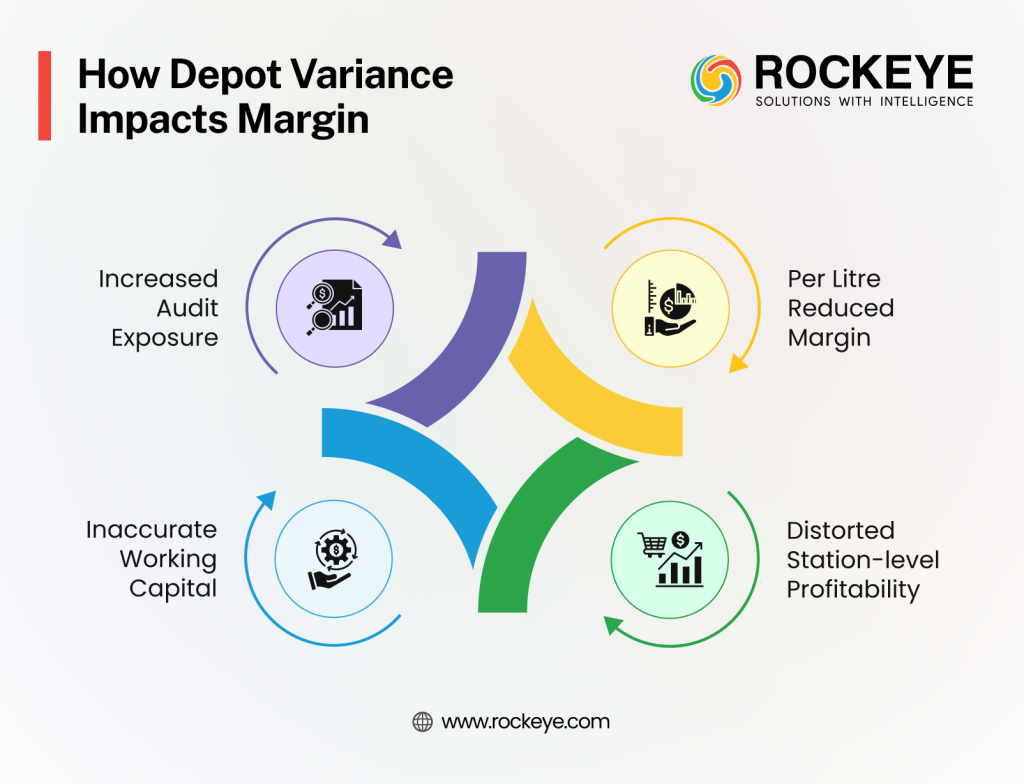
Key margin impacts include:
- Reduced gross margin per litre
- Distorted station-level profitability
- Inaccurate working capital positions
- Increased audit exposure during regulatory reviews
Over time, depot variance weakens financial predictability and undermines confidence in reported Kenyan fuel station profits.
Also read: How AI-Powered Terminal & Throughput Management Cuts Downtime by 30–50%
Depot Variance in Kenya and Its Role in Margin Erosion Across Fuel Networks
Minimizing fuel retail margin erosion Kenya wide requires visibility across the entire value chain. Unfortunately, many fuel networks still operate with fragmented systems where depots, transporters, and stations function in silos.
This fragmentation makes it difficult to calculate fuel station margin loss accurately. Variance investigations become reactive, often triggered only during audits or period-end reviews.
Common contributors to margin variance across fuel networks include:
- Lack of real-time depot release verification
- Manual reconciliation between depot and station records
- Delayed variance reporting
- Inconsistent temperature compensation practices
- Limited oversight of third-party logistics movements
Without structured depot variance reporting best practices, leadership teams remain blind to where margins are leaking.

The Link Between Depot Variance and Compliance Risk in Kenya
Depot variance not only impacts profitability. It also increases regulatory risk. KRA audits fuel stations Kenya-wide often focus on inventory accuracy, tax compliance, and reconciliation integrity.
Inconsistent records between depot releases, transport documentation, and station sales raise red flags during audits. Compliance requirements in petroleum Kenya-wide demand clear traceability of fuel movement and accurate stock records.
When variance is not properly documented and explained, fuel marketers face penalties, reputational damage, and prolonged audit engagements.
Why Traditional Systems Fail to Control Depot Variance
Many oil marketers rely on ERP Systems to manage inventory and accounting. While these systems are effective for recording transactions, they are not designed to control fuel movement in real time.
ERP Systems typically record depot issues and station receipts as separate events. Without a unifying commercial control layer, discrepancies remain unresolved until reconciliation cycles are completed.
This delay allows depot variance to persist unnoticed, contributing to margin erosion and operational disputes.
Strengthening Control Through Fluid Terminal Management
Fluid terminal management plays a critical role in reducing depot variance. By digitizing depot operations, fuel networks gain accurate visibility into release quantities, meter readings, and loading events.
When integrated with downstream systems, fluid terminal management ensures that what leaves the depot is automatically validated against what is received and sold. It creates a single source of truth across the fuel supply chain.
Improved terminal visibility enables faster variance detection and reduces reliance on manual adjustments.
Closing the Gap at Retail With Smart Station Management
Depot variance often becomes visible only at the retail level. Smart station management systems provide real-time insight into tank levels, sales volumes, and reconciliation status at fuel stations.
By combining station-level data with depot release information, oil marketers can identify discrepancies early and prevent cumulative losses.
Smart station management also supports:
- Accurate calculation of Kenyan fuel station profits
- Faster investigation of the margin variance of fuel networks
- Improved accountability at the station level
- Better decision-making around pricing and replenishment
The Role of Vehicle Tracking System in Fuel Logistics Optimization Kenya
Transport is a critical link between the depot and the station. Without visibility into vehicle movement, fuel logistics optimization Kenya wide remains incomplete.
A vehicle tracking system provides real-time monitoring of fuel tankers, delivery routes, stoppages, and arrival times. When integrated with depot and station data, it strengthens control over fuel movement and reduces unexplained variance.
Transport visibility ensures that depot variance is not attributed to assumptions, but investigated using factual movement data.
Best Practices for Depot Variance Reporting and Reconciliation
Reducing depot variance requires discipline, consistency, and automation. Leading oil marketers adopt structured reporting and reconciliation practices that operate continuously rather than periodically.
Effective fuel stock reconciliation checklist practices include:
- Daily reconciliation of depot releases versus station receipts
- Automated variance alerts beyond acceptable thresholds
- Clear ownership for variance resolution
- Integration of tank gauging systems benefits Kenya-wide
- Transparent audit trails for compliance and management review
These practices turn depot variance into a visible operational metric rather than a hidden financial risk.
Maximizing Profit Fuel Station Kenya Wide Through Control
Maximizing profit at fuel station Kenya wide is not only about increasing sales volume. It is about protecting every litre that moves through the network.
When depot variance is controlled, oil marketers achieve:
- Stable oil marketers’ margins Kenya-wide
- Predictable working capital cycles
- Reduced audit risk
- Stronger confidence in financial reporting
Control-driven operations enable leadership teams to focus on growth rather than loss containment.
Strategic Takeaway for Fuel Network Leaders
Depot variance is not an unavoidable cost of doing business. It is a controllable risk.
Fuel networks that invest in integrated visibility across depots, transport, and stations consistently outperform those that rely on fragmented systems and delayed reconciliation.
In a regulated environment, margin protection comes from precision, not scale. Leaders who address depot variance proactively safeguard profitability and build resilient fuel operations.

Frequently Asked Questions
What does depot variance mean in fuel operations?
Depot variance refers to the difference between fuel quantities issued from depots and the quantities received or recorded downstream. It represents a potential loss that directly affects margins.
How does depot variance affect fuel margins Kenya-wide?
Depot variance reduces sellable volume without reducing cost, which directly erodes fuel margins Kenya-wide and weakens profitability for oil marketing companies.
What are the main causes of fuel stock loss in Kenya?
Measurement inaccuracies, temperature variations, manual handling errors, transport gaps, and delayed reconciliation commonly cause fuel stock loss in Kenya.
How do fuel prices impact Kenya’s influence on margin sensitivity?
Fuel price impacts Kenya-wide increase margin sensitivity because regulated pricing leaves little room to absorb losses caused by depot variance or shrinkage.
Why are KRA audits of fuel stations in Kenya focused on reconciliation?
KRA audits fuel stations Kenya wide focus on reconciliation to ensure tax compliance, inventory accuracy, and traceability of fuel movement across the supply chain.
How can oil marketers manage fuel shrinkage at petrol stations?
Oil marketers manage fuel shrinkage by integrating tank gauging systems, smart station management, and real-time reconciliation across depot and retail operations.
How does depot variance impact OMC margins over time?
Depot variance impacts OMC margins by accumulating small volume losses that compound over time, reducing overall profitability and increasing compliance risk.