
Across Kenya, Malaysia, and Indonesia, pricing volatility is no longer an occasional challenge. It has become a constant commercial risk. Fluctuating input costs, currency movements, complex distributor networks, and localized pricing policies make it increasingly difficult for leadership teams to maintain consistent margins.
For many organizations, pricing and margin issues are discovered too late. Variance is identified during month-end reviews or audit cycles, long after revenue has leaked and corrective action is no longer possible.
Global leaders are responding by adopting real-time commercial control, enabling them to detect pricing and margin variance early and act before it escalates into material financial loss.
The Hidden Cost of Pricing and Margin Variance
Pricing variance rarely appears as a single large failure. It accumulates quietly across transactions, regions, and channels, making it difficult to detect without dedicated controls.
Common contributors include:
- Inconsistent pricing across regions and dealer networks
- Manual overrides without structured approval
- Delayed updates to price lists and cost components
- Incorrect application of contract terms
- Lack of visibility into realized margins
These issues may appear manageable. Collectively, they create systemic margin erosion that directly impacts profitability and executive credibility.
This is why forward-looking organizations rely on price monitoring solutions that operate continuously, not retrospectively.
Why Traditional Pricing Controls Fail in Global Operations
Many enterprises depend on ERP pricing rules, spreadsheets, and periodic reporting. While these tools support transaction processing, they were never designed to manage pricing risk at scale.
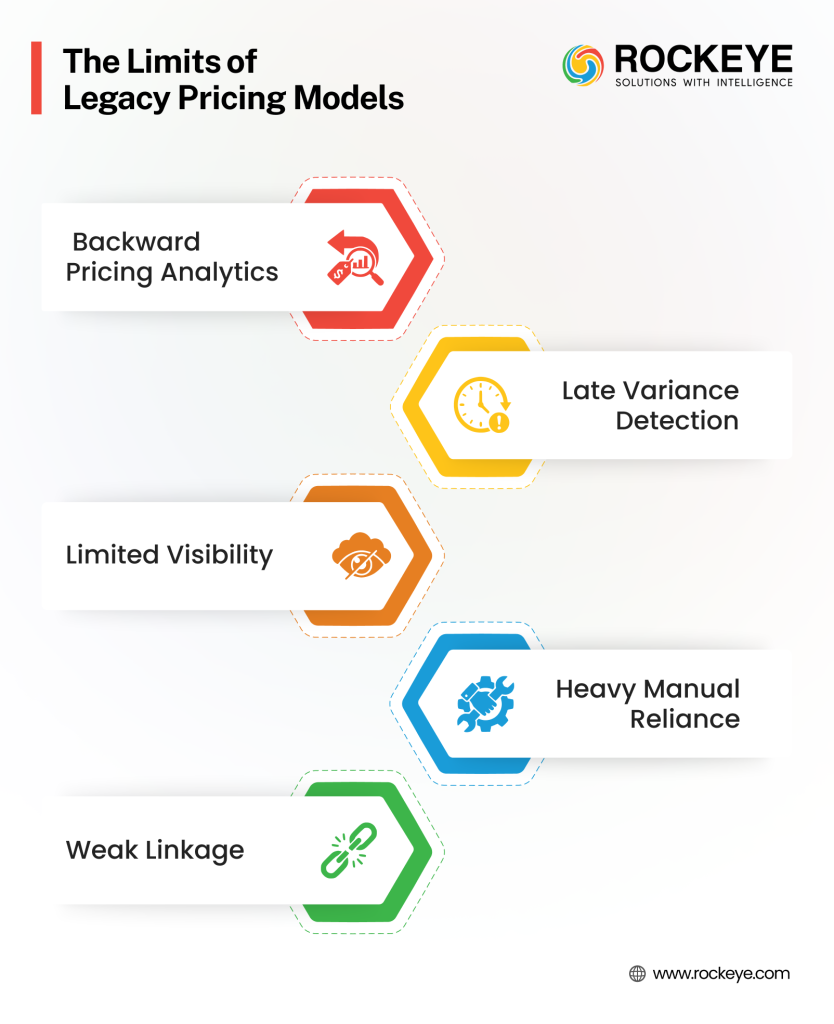
Key limitations of traditional pricing approaches
- Pricing analytics are backward-looking
- Variance is detected after financial close
- Limited visibility across countries and business units
- Heavy reliance on manual review and intervention
- Weak linkage between pricing decisions and margin outcomes
As organizations expand across markets like Kenya, Malaysia, and Indonesia, these gaps widen. What once worked locally becomes ineffective globally.
This has driven the shift toward global pricing management supported by real-time commercial control.
Must Read: Dealer Network Leakage in Vietnam: How a Commercial Control Layer Stops
Real-time Pricing Analytics Platform as a Control Layer
A modern pricing analytics platform functions as a live control layer rather than a reporting tool. It continuously monitors pricing behavior, margin performance, and cost movements against predefined commercial rules.
What real-time pricing analytics enables
- Immediate identification of price deviations
- Continuous margin tracking at the transaction level
- Early alerts for abnormal discounting
- Visibility across regions, channels, and customers
- Faster executive intervention
For leadership teams, this means fewer surprises and stronger confidence in commercial performance.

Variance Detection Tools That Prevent Margin Escalation
Variance detection tools are designed to stop small discrepancies from becoming structural problems. Their role is preventive, not investigative.
Types of variance detected in real time
- Price variance against approved price lists
- Margin variance against target contribution levels
- Cost variance driven by logistics or currency changes
- Contract variance due to incorrect term application
- Channel variance between direct and indirect sales
By detecting variance at the point of execution, organizations can intervene while transactions are still controllable.
Pricing Variance Escalates Faster Than Most Leaders Realize
Pricing variance does not wait for quarterly reviews. A minor deviation repeated across hundreds of transactions compounds rapidly. Without real-time controls, leadership teams often underestimate the speed at which margins deteriorate.
Real-time commercial control surfaces these deviations immediately, enabling corrective action before losses accumulate.
Margin Leakage Often Hides Inside Approved Processes
Not all margin loss comes from unauthorized actions. Many losses occur within approved pricing structures due to outdated assumptions, delayed updates, or incomplete cost visibility.
Without robust variance detection tools, these issues remain hidden because they technically comply with existing workflows while silently eroding profitability.
Also read: Boost Fuel Retail Margins by 15–25% with Integrated Downstream Commercial Control
Pricing Waterfall Analysis for Executive-level Clarity
Pricing waterfall analysis provides a structured breakdown of how the final realized price is formed, from list price to net margin.
Why pricing waterfall analysis matters
- Reveals exactly where the margin is lost
- Quantifies the impact of discounts, rebates, and incentives
- Connects pricing decisions directly to profitability
- Enables accountability across commercial teams
When embedded into a real-time pricing analytics platform, pricing waterfall analysis becomes a strategic decision tool rather than a static report.
Transaction-level Visibility Is the Missing Link
Many organizations analyze pricing at an aggregated level, masking transaction-level issues. Real-time commercial control brings visibility down to individual transactions, enabling leadership to pinpoint the exact source of margin variance.
This granularity is essential for accurate pricing waterfall analysis and effective decision-making.
Commercial Control Best Practices for Global Enterprises
Organizations that successfully manage pricing and margins across multiple regions follow disciplined commercial control best practices.
Common best practices among global leaders
- Centralized pricing governance with controlled local execution
- Real-time variance detection instead of periodic audits
- Automated approval workflows for pricing exceptions
- Continuous monitoring of realized margins
- Clear ownership for pricing outcomes
These practices ensure pricing discipline scales with business growth rather than deteriorating under complexity.
Regional Complexity Multiplies Pricing Risk
Operating across Kenya, Malaysia, and Indonesia introduces diverse tax regimes, logistics costs, currencies, and regulatory requirements. These factors significantly increase pricing risk if managed in isolation.
A unified pricing analytics platform supports regional flexibility while maintaining centralized governance, ensuring consistency without sacrificing local relevance.
Commercial Risk Detection Software as a Strategic Asset
Commercial risk detection software has evolved from a back-office control into a strategic leadership tool.
What commercial risk detection software delivers
- Early identification of revenue leakage patterns
- Protection against unauthorized or inconsistent pricing
- Audit-ready pricing and margin data
- Reduced dependence on manual controls
- Faster response to market volatility
For organizations operating in emerging and regulated markets, this capability is critical for sustainable growth.
Early Detection Protects Both Revenue and Reputation
Pricing errors impact more than margins. They can damage customer trust, distributor relationships, and regulatory standing.
By identifying anomalies early, commercial risk detection software enables corrective action before discrepancies escalate into disputes or audit findings.
How Global Real-time Commercial Control Enables Confident Growth
ROCKEYE is purpose-built to deliver real-time commercial control, not generic ERP functionality. It operates as a dedicated commercial control system that sits above transactional platforms.
What you can achieve by working with ROCKEYE
- Continuous price monitoring across markets and channels
- Real-time margin variance detection before escalation
- Embedded pricing waterfall analysis for executive clarity
- Automated controls aligned with commercial policies
- Centralized visibility with local execution
ROCKEYE enables you to detect, analyze, and correct pricing and margin variance while transactions are still active.
For leadership teams in Kenya, Malaysia, and Indonesia, this means predictable margins, stronger governance, and fewer commercial surprises.

Conclusion: Detect Variance Before It Becomes a Crisis
Pricing and margin variance will always exist in dynamic markets. The difference lies in how early it is detected and how decisively it is addressed.
Global real-time commercial control shifts organizations from reactive damage control to proactive margin protection.
When pricing behavior is monitored continuously and governed effectively, margins stop leaking quietly and start supporting long-term growth.
Frequently Asked Questions
How do price monitoring solutions help prevent margin loss?
Price monitoring solutions track pricing activity in real time and compare it against approved rules and thresholds. It enables organizations to detect deviations early and correct them before they impact overall profitability.
What is the role of a pricing analytics platform in global pricing management?
A pricing analytics platform provides continuous visibility into pricing and margin performance across regions. It enables consistent global pricing management while accommodating local market dynamics.
Why are variance detection tools critical for commercial control?
Variance detection tools identify pricing, cost, and margin deviations as they occur. It prevents small discrepancies from compounding into significant financial losses and strengthens commercial governance.
How does pricing waterfall analysis support executive decision-making?
Pricing waterfall analysis clearly shows how each adjustment affects the final realized price and margin. Executives gain transparency into where value is created or lost, enabling informed pricing decisions.
How does commercial risk detection software support compliance and audits?
Commercial risk detection software maintains a transparent and traceable record of pricing decisions, approvals, and outcomes. It improves audit readiness, reduces compliance risk, and strengthens confidence in reported performance.