


If you run a palm oil milling, refining, or processing operation in Indonesia or Malaysia, you already know that managing daily operations can feel like juggling fire. Between fluctuating Crude Palm Oil (CPO) market prices, strict moisture and Free Fatty Acid (FFA) quality limits, complex mass balance tracking, and increasingly stringent international compliance regulations like EUDR, there is zero margin for error.
To stay competitive, palm oil processors and traders across Southeast Asia are stepping away from legacy spreadsheets and generic enterprise software. But if you have started researching modern enterprise resource planning (ERP) platforms, you have likely realized that most generic systems simply aren’t built for liquid bulk logistics, refinery yield variations, or multi-tiered sustainability reporting. Understanding how to choose palm oil ERP software that aligns with your specific processing needs, local tax regulations, and trading dynamics is the single most important decision your operational leadership will make this decade.
According to the USDA Foreign Agricultural Service 2026 report, global palm oil output continues to reach record levels, with Indonesia alone projected to produce 48 million metric tons in the 2026/27 marketing year. As operational scale explodes across Southeast Asia, having robust digital control over your mills, processing facilities, and distribution channels is no longer optional, it is essential for protecting your profit margins.
In this palm oil software buyer’s guide, we will walk you through everything you need to know to evaluate, compare, and select a platform that drives measurable operational excellence.

What Makes Palm Oil Processing and Mill Management So Complex?
Unlike standard discrete manufacturing where you assemble clear parts into a finished product, palm oil milling and refining deals with continuous liquid processing, volatile raw material inputs, co-products, and biological degradation. A one-size-fits-all ERP system usually crumbles under these unique demands.
Here are the three core operational challenges every mill, refinery, and trading business faces:
1. Mass Balance and Yield Reconciliation
When raw materials enter the processing facility, converting them into CPO, Palm Kernel Oil (PKO), Refined Bleached Deodorized (RBD) Olein, and Stearin involves inevitable process losses. If your software cannot track real-time extraction rates, steam consumption, and mass balance across every stage of processing, invisible yield leaks will eat away at your bottom line without anyone noticing.
2. Quality Assurance and FFA/Moisture Variance
Quality is directly tied to value in the palm oil sector. Free Fatty Acid (FFA) levels, moisture content, and impurity percentages dictate pricing grades, storage allocations, and blend recipes. Your software must automatically capture lab analysis results right at the weighbridge and processing line, preventing off-spec oil from contaminating high-grade storage tanks.
3. Complex Bulk Logistics and Multi-Currency Trading
Managing bulk tanker trucks, port tank terminals, vessel shipments, and export documentation across Indonesia, Malaysia, and global export destinations requires seamless integration. Add multi-currency contracts, hedging, and export levies to the mix, and manual data entry quickly becomes a major liability.
Don’t Miss: Top 10 Challenges Palm Oil Mills Face in Malaysia and How Software Solutions Help
Generic ERP vs. Specialized Palm Oil Software
Many business leaders wonder whether they can simply customize a general-purpose ERP platform like standard SAP, Oracle, or Microsoft Dynamics. While generic systems excel at core accounting, customizing them to handle palm oil refining, density conversions, and tank management often leads to budget overruns and never-ending software updates.
Here is how a generic ERP compares against an industry-tailored palm oil management solution:
| Operational Capability | Generic Enterprise ERP | Purpose-Built Palm Oil ERP |
| Weighbridge & Tank Integration | Requires costly third-party custom code | Native real-time integration with weighbridges, flow meters, and tank dip sensors |
| Mass Balance & Yield Loss Tracking | Basic inventory management; cannot handle process shrink/yield variations | Automatic mass balance calculation per processing batch with real-time variance alerts |
| Lab Quality Control (LIMS) | Separate LIMS system required with complex integration bridges | Fully embedded quality control tracking tied directly to weighbridge tickets and tank transfers |
| Commodity Trading & Contracts | Standard sales order processing (fixed pricing) | Advanced commodity trading management with multi-currency pricing, premium/discount formulas, and contract hedging |
| Sustainability Compliance | Manual tracking via spreadsheets | Automated traceability mapping supporting EUDR, RSPO, ISPO, and MSPO certifications |
How to Choose Palm Oil ERP Software: A Step-by-Step Guide
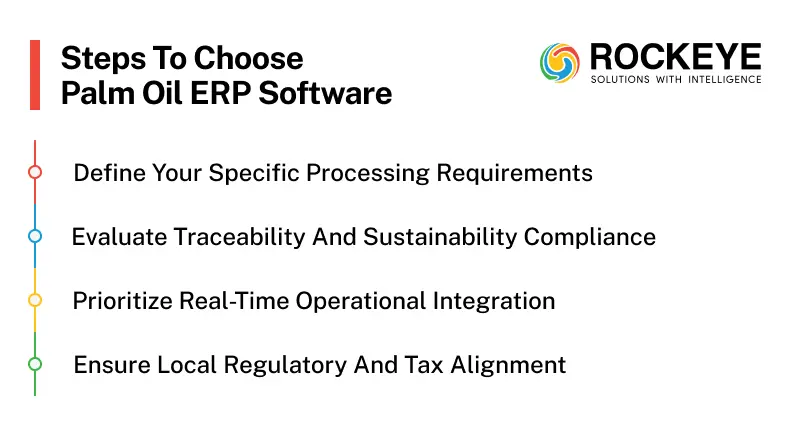
Choosing the right platform isn’t just an IT project; it’s a transformation that impacts your plant engineers, lab technicians, finance teams, and supply chain managers. Here is a practical roadmap to guide your selection process:
Step 1: Define Your Specific Processing Requirements
Start by mapping your exact facility workflows. Are you operating independent CPO mills, integrated refinery complexes, fractionating plants, or oleochemical facilities?
- List your critical operational bottlenecks (e.g., weighbridge queues, inventory discrepancies, delayed monthly financial closes).
- Outline all required integrations, such as weighbridge scales, SCADA/PLC systems, lab equipment, and automated tank gauging system tools.
- Determine multi-site visibility requirements across regional headquarters and remote facility locations.
Step 2: Evaluate Traceability and Sustainability Compliance
With global buyers enforcing strict deforestation and sustainability standards, your software must provide end-to-end supply chain visibility. When analyzing how to choose palm oil ERP software, test whether the system can map batch lineage from raw material intake all the way to refined export shipments. It should instantly generate audit-ready documentation for RSPO, ISPO, MSPO, and European Union Deforestation Regulation (EUDR) mandates.
Step 3: Prioritize Real-Time Operational Integration
A delayed data entry model means you are making decisions on yesterday’s operational problems. Look for palm oil software that captures data directly at the source automated weighbridge captures, instant lab readings, and automated tank volume calculations using standard temperature and density tables (such as ASTM tables).
Step 4: Ensure Local Regulatory and Tax Alignment
Operating in Indonesia or Malaysia means dealing with specific tax frameworks, export duties, and localized regulatory reports (such as e-Faktur in Indonesia or SST accounting in Malaysia). Choosing a vendor that understands regional compliance saves months of localized custom coding.
Why Your Palm Oil ERP Checklist Needs Industry-Specific Features
To keep your evaluation team focused on what truly matters, build your evaluation around a specialized palm oil ERP checklist. Make sure any software vendor you consider ticks off the following non-negotiable capabilities:
- Automated Weighbridge Integration: Direct connection to electronic weighbridges with driver identification, gross/tare weight capture, automated ticket generation, and anti-tampering security controls.
- Integrated Lab & Quality Control: Automatic grading of raw materials and finished oils, with rule-based price adjustments (penalties or bonuses) based on FFA, moisture, and impurity percentages.
- Refinery & Processing Management: Recipe-driven batch processing, utility consumption tracking (steam, power, chemicals), and real-time yield analysis across refining, bleaching, and deodorizing (RBD) stages.
- Tank Farm & Inventory Control: Real-time tank volume tracking with automatic temperature-to-density conversions, tank transfer logs, and blending calculations.
- Commodity Trading & Hedging: End-to-end management of CPO and refined product sales contracts, contract execution tracking, freight management, and risk exposure monitoring.
- Sustainability & Traceability Engine: Digital chain-of-custody tracking (IP, SG, MB models) with geospatial data mapping to verify compliant sourcing.

Streamlining Your Palm Oil Operations with ROCKEYE
Finding a software partner that understands the intricate dynamics of the Southeast Asian palm oil industry can be challenging. That is where ROCKEYE Palm Oil Solutions stands out.
ROCKEYE offers a comprehensive, industry-tailored enterprise platform designed specifically for palm oil processors, refiners, mill operators, and commodity traders. Built with deep regional expertise across Indonesia and Malaysia, ROCKEYE bridges the gap between floor operations and executive leadership.
Key Capabilities Include:
- End-to-End Processing Visibility: Monitor real-time extraction yields, processing plant efficiencies, and utility consumption in a unified dashboard.
- Seamless Weighbridge & Lab Automation: Eliminate manual data entry errors and prevent fraud with automated weighbridge controls and embedded LIMS workflows.
- Advanced Mass Balance & Tank Management: Gain accurate inventory numbers across all storage tanks with automated density and temperature compensation algorithms.
- Turnkey Sustainability & Regulatory Compliance: Effortlessly maintaining RSPO, ISPO, MSPO, and EUDR compliance with integrated supply chain traceability tools.
- Built for Regional Scale: Native support for localized tax structures, multi-currency commodity contracts, and multi-facility enterprises across Southeast Asia.
Ready to see how a dedicated, industry-specific ERP can transform your mill or refinery operations? You can request a demo of our palm oil solution to speak with our industry experts and explore a personalized walkthrough of the platform.
Conclusion: Making the Right Investment for Sustainable Growth
Selecting new enterprise software is one of the most consequential strategic investments your processing business will undertake. While generic systems may promise flexibility, purpose-built platforms eliminate the risk, delay, and sky-high costs of custom software development.
By understanding how to choose palm oil ERP software based on real-time operational integration, robust quality control, accurate mass balance tracking, and built-in sustainability tools, you position your organization for long-term efficiency and market leadership. Take the time to evaluate your team’s everyday needs, test vendors against a strict functional checklist, and choose a partner that truly understands the palm oil value chain.
Frequently Asked Questions
How much does palm oil ERP software cost?
Palm oil ERP software pricing depends on several operational factors rather than a fixed licence fee. The biggest cost drivers include the number of processing facilities, refinery complexity, automation requirements, users, and integrations with weighbridges, laboratory systems, tank gauging, PLC/SCADA platforms, and accounting software.
Most implementations include:
- Software licences or subscription fees
- Implementation and configuration
- Data migration
- Integration development
- User training
- Ongoing support and upgrades
A small independent mill typically requires a simpler deployment than a multi-site refinery operating across Indonesia and Malaysia with commodity trading and sustainability reporting.
Instead of comparing vendors solely on upfront cost, evaluate the total cost of ownership over five to ten years. A purpose-built palm oil ERP often reduces manual reconciliation, inventory losses, compliance risks, and reporting effort, creating measurable operational savings that outweigh the initial investment.
What ROI can a palm oil ERP deliver?
The return on investment from palm oil ERP software comes from operational efficiency rather than software alone. Organisations commonly achieve ROI through:
- Reduced inventory discrepancies
- Improved extraction yield monitoring
- Faster month-end financial close
- Lower manual data entry
- Reduced weighbridge fraud
- Better refinery planning
- Improved tank utilisation
- Faster sustainability audits
- Reduced compliance penalties
The highest returns typically come from integrating operational data with finance and supply chain information, allowing management to identify production losses before they affect profitability.
How long does it take to implement palm oil ERP software?
Implementation timelines depend on business size and operational complexity. Typical projects include:
- Requirements analysis
- Process mapping
- System configuration
- Master data migration
- Equipment integration
- User acceptance testing
- Employee training
- Go-live support
A single processing facility generally requires less time than a multi-country enterprise with integrated refining, trading, and export operations. A phased implementation often reduces operational disruption while allowing employees to adapt to new workflows gradually.
What are the biggest mistakes companies make when buying palm oil ERP software?
Many ERP projects fail because organisations focus on software features rather than operational fit. Common mistakes include:
- Choosing generic manufacturing ERP
- Ignoring weighbridge automation
- Overlooking tank farm management
- Underestimating data migration
- Selecting vendors without palm oil expertise
- Failing to involve production teams
- Ignoring sustainability reporting requirements
- Not planning user training
A successful implementation begins with understanding operational processes before evaluating software vendors.
Can palm oil ERP integrate with existing factory equipment?
Yes. Modern palm oil ERP platforms are designed to connect with operational technology across the processing facility, including:
- Electronic weighbridges
- Tank gauging systems
- Flow meters
- PLC and SCADA systems
- Laboratory instruments
- Barcode scanners
- RFID devices
- Financial software
- Warehouse systems
Integration enables automatic data capture, reducing manual entry while improving operational visibility and reporting accuracy.
What reports should a palm oil ERP generate?
A purpose-built system should provide operational and executive reporting, including:
- Daily mill production
- Extraction efficiency
- FFA trends
- Moisture analysis
- Yield variance
- Tank inventory
- Utility consumption
- Production costs
- Contract fulfilment
- Commodity exposure
- Sustainability traceability
- Financial dashboards
Real-time reporting enables managers to identify issues quickly instead of waiting for end-of-month reports.
Is cloud or on-premise ERP better for palm oil companies?
Both deployment models have advantages. Cloud ERP offers:
- Faster deployment
- Lower infrastructure costs
- Automatic updates
- Remote access
- Easier scalability
On-premise ERP may be preferred where organisations require:
- Full control over infrastructure
- Strict internal security policies
- Limited internet connectivity
- Custom integration with legacy systems
The right choice depends on business requirements, IT strategy, regulatory needs, and operational locations.
How does ERP reduce losses in palm oil processing?
ERP reduces operational losses by improving visibility across production. It helps organisations:
- Monitor extraction efficiency
- Detect abnormal yield losses
- Prevent inventory discrepancies
- Reduce weighbridge fraud
- Improve batch traceability
- Optimise refinery recipes
- Monitor utility consumption
- Reduce production downtime
Real-time operational data enables managers to respond before small issues become costly production losses.
What departments benefit most from palm oil ERP?
Palm oil ERP connects multiple business functions through a shared operational platform. Departments that typically benefit include:
- Production
- Processing
- Refining
- Laboratory
- Procurement
- Finance
- Sales
- Logistics
- Warehouse
- Sustainability
- Executive management
Integrated information improves collaboration while reducing duplicate data entry across departments.
How do you evaluate palm oil ERP vendors?
A structured vendor evaluation should assess more than software features.
Key criteria include:
- Palm oil industry expertise
- Successful customer implementations
- Integration capabilities
- Regulatory compliance support
- Scalability
- User experience
- Technical support
- Local presence
- Product roadmap
- Implementation methodology
- Training programmes
- Long-term ownership costs
Requesting a live demonstration using real operational scenarios provides a more accurate assessment than relying on feature lists alone.