


The Digital Shift Is No Longer Optional
Malaysia’s palm oil industry has long been a cornerstone of the nation’s economy. But as the industry evolves, midstream and downstream businesses are facing increasing pressure to become more efficient, agile, and data-driven.
Whether you’re operating a palm oil mill, refinery, oleochemical facility, specialty fats manufacturing plant, trading company, or distribution network, the challenges are becoming more complex every year.
Rising operational costs, volatile market conditions, stricter compliance requirements, supply chain disruptions, and increasing customer expectations are forcing business leaders to rethink how their organizations operate.
In 2026, one trend is becoming impossible to ignore:
More Malaysian palm oil companies are moving from legacy systems to cloud-based business management platforms.
The goal isn’t simply modernization. It’s about gaining the visibility, control, and flexibility needed to compete in an increasingly digital industry.
Why Traditional Systems Are Holding Palm Oil Businesses Back
Many midstream and downstream palm oil companies still rely on a combination of spreadsheets, standalone software, manual reporting processes, and disconnected systems.
At first glance, these tools may seem sufficient.
However, as operations grow, these fragmented systems create significant challenges:
- Delayed reporting
- Duplicate data entry
- Limited operational visibility
- Inventory inaccuracies
- Slow decision-making
- Higher compliance risks
- Poor cross-department collaboration
When critical information is scattered across multiple systems, leadership teams struggle to get a clear picture of business performance.
In today’s fast-moving market, delayed information often leads to delayed decisions, and delayed decisions can directly impact profitability.
This is one of the biggest reasons why Digital Transformation Malaysia initiatives are accelerating across the palm oil sector.
Real-time Data Has Become a Competitive Advantage
In the past, business leaders relied on weekly or monthly reports to evaluate performance.
Today, that’s simply not fast enough.
Modern Cloud ERP for Palm Oil Industry solutions provide real-time access to critical business information, allowing decision-makers to respond quickly to changing market conditions.
Instead of waiting for reports to be consolidated manually, executives can instantly view:
- Production performance
- Refinery throughput
- Inventory levels
- Procurement activities
- Sales performance
- Logistics status
- Financial metrics
- Supply chain operations
With real-time visibility, organizations can identify issues earlier, reduce inefficiencies, and make faster strategic decisions.
For C-suite leaders, access to accurate and timely information is no longer a luxury—it is a competitive necessity.
Supply Chain Complexity Is Driving Digital Adoption
The palm oil value chain involves multiple moving parts.
Raw material sourcing, production planning, inventory management, logistics coordination, exports, customer fulfillment, and regulatory compliance must all work together seamlessly.
A disruption in one area can impact the entire business.
This is why Palm Oil Supply Chain Management has become a major focus for industry leaders.
Cloud-based systems provide a centralized platform that connects departments and stakeholders across the supply chain.
This enables organizations to:
- Improve inventory visibility
- Reduce operational bottlenecks
- Optimize procurement processes
- Enhance demand forecasting
- Improve order fulfillment accuracy
- Increase supply chain resilience
Companies that achieve greater supply chain visibility are often better positioned to manage uncertainty and maintain profitability.
Industry 4.0 Is Transforming Palm Oil Manufacturing
The conversation around Industry 4.0 Palm Oil Malaysia has moved beyond theory.
It is now a business reality.
Leading palm oil companies are integrating cloud platforms with advanced technologies such as:
- Internet of Things (IoT)
- Artificial Intelligence (AI)
- Automation systems
- Business Intelligence tools
- Production monitoring systems
- Digital quality control platforms
These technologies generate valuable operational data that can be analyzed in real time. For manufacturers and refiners, this means greater visibility into:
- Production efficiency
- Equipment utilization
- Process optimization
- Downtime reduction
- Product quality
- Resource consumption
The result is a smarter, more responsive operation capable of adapting quickly to changing business conditions.
Better Inventory Management Means Better Profitability
Inventory management remains one of the biggest operational challenges for palm oil businesses.
Excess inventory ties up working capital.
Insufficient inventory can disrupt production and customer deliveries.
Traditional inventory management methods often struggle to provide accurate, real-time information.
A modern Cloud-based Business Management System helps organizations maintain complete visibility across warehouses, storage facilities, production sites, and distribution centers.
Benefits include:
- Improved inventory accuracy
- Reduced stock discrepancies
- Faster inventory reconciliation
- Better demand planning
- Lower carrying costs
- Increased customer satisfaction
For businesses operating on tight margins, better inventory management can have a significant impact on overall profitability.
Regulatory Compliance Is Becoming More Complex
Compliance requirements continue to evolve across the global palm oil industry.
Customers, regulators, and stakeholders increasingly demand greater transparency, traceability, and accountability.
Businesses must often manage requirements related to:
- Product traceability
- Sustainability reporting
- Export documentation
- Financial compliance
- Operational audits
- Quality assurance processes
Manual compliance processes consume valuable resources and increase the risk of errors.
Cloud-based platforms simplify compliance by centralizing information and automating reporting processes.
This not only reduces administrative workload but also helps organizations remain audit-ready at all times.
For many companies, digital transformation is now viewed as a key enabler of compliance and risk management.
Cloud Technology Supports Business Growth
As palm oil businesses expand, operational complexity increases.
New facilities, additional product lines, growing customer bases, and international expansion all create new challenges.
Legacy systems often struggle to scale alongside business growth.
Cloud platforms provide the flexibility needed to support expansion without requiring significant infrastructure investments.
Organizations can:
- Add users easily
- Connect multiple facilities
- Standardize processes
- Improve data consistency
- Support cross-border operations
- Scale efficiently
This scalability makes cloud technology particularly attractive for growing midstream and downstream palm oil companies.
Collaboration Across Departments Is Easier Than Ever
Many organizations still operate with departmental silos. Production teams use one system. Finance teams use another. Supply chain teams rely on spreadsheets. Sales teams maintain separate records. The result is fragmented information and inconsistent reporting.
A modern Palm Oil Manufacturing Software platform creates a single source of truth across the organization.
Departments can collaborate more effectively across:
- Production
- Operations
- Procurement
- Supply Chain
- Logistics
- Sales
- Finance
- Quality Assurance
When everyone works from the same data, businesses become more agile, efficient, and aligned.
Why 2026 Is a Turning Point for Malaysian Palm Oil Businesses
Several factors are accelerating cloud adoption across the industry.
Rising Operating Costs
Organizations are under pressure to improve efficiency and reduce waste.
Increased Market Competition
Companies need faster access to information to maintain a competitive edge.
Higher Customer Expectations
Customers expect reliable delivery, transparency, and consistent product quality.
Evolving Compliance Requirements
Regulatory complexity continues to increase across domestic and international markets.
Technology Maturity
Cloud platforms are now more secure, scalable, and cost-effective than ever before.
Together, these trends are making cloud transformation a boardroom priority across Malaysia’s palm oil industry.

How ROCKEYE Can Help
Successful digital transformation requires more than just software. It requires a solution that aligns with the unique operational needs of palm oil businesses.
ROCKEYE helps palm oil mills, refineries, manufacturers, traders, and distributors streamline operations through a centralized cloud-based business management platform.
By connecting critical business functions into a single system, ROCKEYE enables organizations to improve visibility, increase efficiency, and make faster, data-driven decisions.
With ROCKEYE, businesses can:
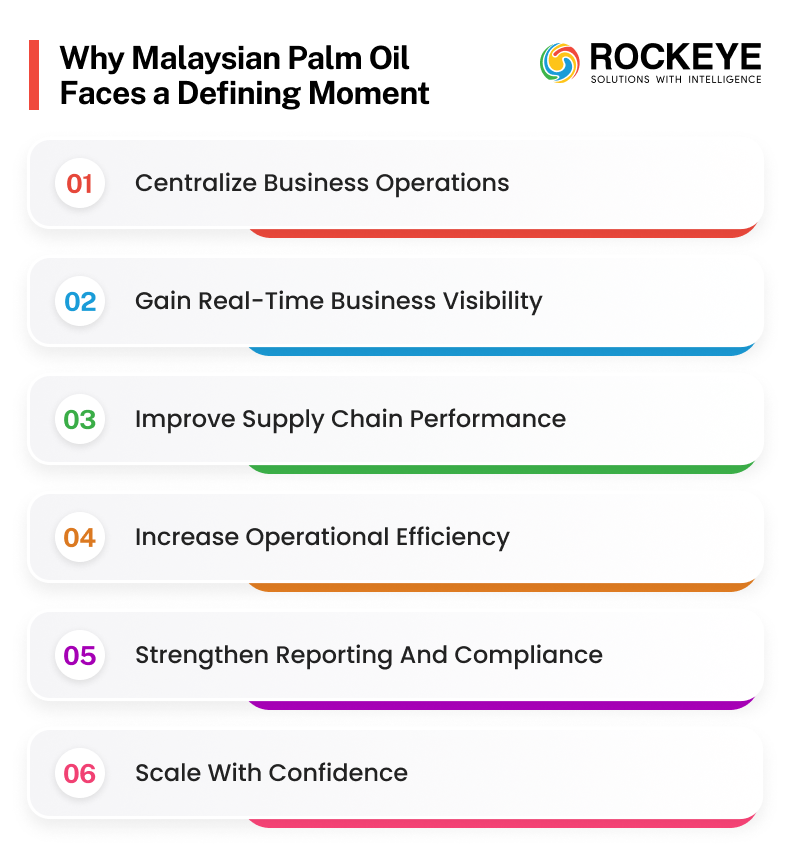
Centralize Business Operations
Unify finance, procurement, inventory, production, sales, and reporting into one integrated platform.
Gain Real-Time Business Visibility
Access accurate operational and financial data whenever and wherever it is needed.
Improve Supply Chain Performance
Enhance coordination across procurement, production, warehousing, and distribution processes.
Increase Operational Efficiency
Reduce manual work, eliminate data silos, and streamline workflows across departments.
Strengthen Reporting and Compliance
Generate accurate reports quickly while maintaining greater transparency and accountability.
Scale with Confidence
Support business growth with a flexible cloud-based platform designed to evolve alongside organizational needs.
The Future Belongs to Digitally Connected Palm Oil Businesses
The Malaysian palm oil industry is entering a new phase of digital transformation.
Midstream and downstream businesses can no longer rely on fragmented systems and outdated processes to remain competitive.
Organizations that invest in Cloud systems for Palm Oil industry, Palm Oil manufacturing software, Palm Oil supply chain management, and Cloud-based business management systems are building a foundation for greater efficiency, resilience, and long-term growth.
The gap between digitally enabled businesses and those relying on legacy systems will continue to widen.
The companies that thrive will be those that embrace technology, leverage real-time data, and create connected operations capable of adapting to an increasingly dynamic market.
For palm oil leaders looking to future-proof their organizations, the move to the cloud is no longer a question of if, it is a question of when.
Frequently Asked Questions
What is a cloud-based system for palm oil companies?
A cloud-based system is software hosted on secure online servers that enables palm oil businesses to manage operations, production, inventory, procurement, quality control, logistics, and reporting from a centralized platform. For palm oil mills, refineries, oleochemical manufacturers, and distributors, cloud systems provide real-time access to operational data without requiring on-premise infrastructure.
Why are Malaysian palm oil businesses adopting cloud software?
Malaysian palm oil companies are adopting cloud software to improve operational efficiency, gain real-time visibility across processing and distribution activities, and reduce dependence on legacy systems. As supply chains become more complex and compliance requirements increase, cloud-based platforms help businesses streamline workflows, improve collaboration between departments, and make faster data-driven decisions.
Can cloud-based software reduce operational costs?
Yes. Cloud-based software can reduce costs by eliminating expensive server maintenance, lowering IT infrastructure investments, and automating manual processes. Palm oil processors, refiners, and manufacturers can improve resource utilization, reduce administrative workloads, minimize reporting errors, and optimize production planning, resulting in lower operational expenses.
How secure are cloud systems for palm oil data management?
Modern cloud systems use advanced security measures such as data encryption, multi-factor authentication, role-based access controls, automated backups, and continuous monitoring. Many cloud providers comply with internationally recognized security standards, helping palm oil companies protect sensitive production, inventory, financial, and supply chain data while improving disaster recovery capabilities.
What features should palm oil companies look for in cloud software?
Midstream and downstream palm oil businesses should look for cloud software that includes:
- Production and processing management
- Inventory and warehouse tracking
- Procurement and supplier management
- Quality control and batch traceability
- Maintenance and asset management
- Logistics and distribution tracking
- Real-time dashboards and analytics
- Sustainability and compliance reporting
- Multi-site operation management
- Mobile and remote access capabilities
These features help companies improve efficiency, visibility, and decision-making across the value chain.
Can cloud-based systems improve palm oil supply chain visibility?
Yes. Cloud-based systems provide real-time visibility across processing facilities, warehouses, logistics networks, and distribution channels. Businesses can monitor inventory levels, production output, shipment status, supplier performance, and customer deliveries from a single platform. Improved visibility helps reduce delays, enhance traceability, optimize inventory management, and support compliance with sustainability and export requirements.