


The palm oil industry doesn’t have a production problem; it has a visibility problem.
Across Indonesia and Malaysia, mills and refineries process millions of tonnes of fresh fruit bunches every year. Yet many executive teams still make critical operational decisions using yesterday’s reports, disconnected spreadsheets, and fragmented systems.
In an industry where margins are influenced by yield, logistics, compliance, and commodity prices, delayed information is becoming one of the biggest operational risks. That’s why the conversation is shifting from traditional ERP systems to a modern Palm Oil ERP Solution built around real-time visibility, AI-driven intelligence, and connected operations.
Why Palm Oil Operations Need More Than Traditional ERP
Palm oil businesses have become significantly more complex over the last decade.
What was once a production-focused operation now involves procurement planning, mill efficiency, refinery throughput, sustainability reporting, export regulations, biodiesel demand, and increasingly demanding customers.
For executives, the challenge isn’t collecting more data. It’s making sense of the data already scattered across the organization.
Common operational challenges include:
- Plantation data is stored separately from mill operations.
- Manual production reporting that arrives hours or days late.
- Limited visibility into fresh fruit bunch (FFB) quality and transportation.
- Delayed maintenance information leading to unplanned downtime.
- Increasing ESG documentation requirements.
- Difficulty forecasting inventory and production accurately.
Many organizations still rely on legacy ERP systems that were originally designed for finance and inventory management systems rather than real-time operational intelligence.
As a result, leadership teams often react to issues after they occur instead of preventing them. This is exactly where palm oil digital transformation is creating a competitive advantage.
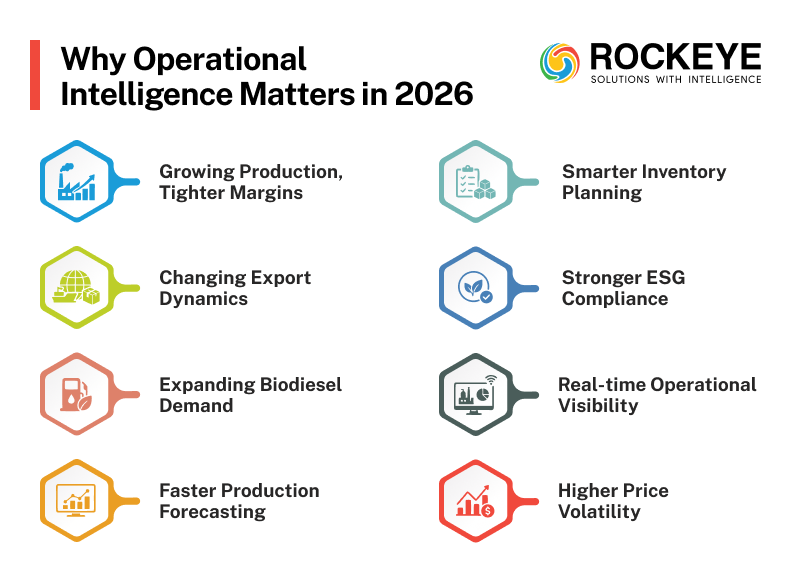
2026 Market Snapshot: Why Operational Intelligence Matters More Than Ever
The business environment for palm oil producers in Southeast Asia continues to evolve rapidly. Production growth, government policies, sustainability requirements, and export dynamics are reshaping how mills and refineries operate.
1. Indonesia: Growth Continues, but Operational Efficiency Matters More
Indonesia remains the world’s largest palm oil producer.
According to research, Indonesia produced approximately 51.98 million metric tonnes of crude palm oil in 2025, with total palm oil production (including palm kernel oil) exceeding 56.91 million tonnes. Production growth in 2026 is expected to slow to around 2–3% due to ageing plantations and yield challenges.
Latest industry estimates also indicate that Indonesian palm oil exports exceeded 32 million tonnes in 2025, while domestic consumption continued to rise due to the government’s biodiesel programme.
For producers, this creates an important reality: “Higher domestic demand means operational efficiency is becoming just as important as production volume.”
2. Indonesia’s Biodiesel Programme Is Reshaping Supply Chains
Indonesia’s B40 biodiesel mandate has already increased domestic palm oil consumption.
Government agencies continue preparing for a potential transition toward B50, although implementation timing depends on technical testing and funding mechanisms. Reuters reports that policymakers are evaluating export levy adjustments to support future biodiesel expansion.
For mills and refiners, this means:
- More volatile domestic demand
- Tighter inventory planning
- Greater need for production forecasting
- Faster decision-making across supply chains
Organizations operating with weekly reporting cycles will increasingly struggle to keep pace.
3. Malaysia: Stable Production, Rising Pressure on Productivity
Malaysia remains the world’s second-largest palm oil producer, but the industry continues to face structural challenges, including labour availability, ageing plantations, and productivity improvements.
Reuters estimates Malaysian crude palm oil production output around 19.7 million tonnes across the latest outlook, while pricing continues to be influenced by Indonesian biodiesel demand, global edible oil markets, and weather conditions.
For Malaysian operators, profitability increasingly depends on:
- Better mill utilisation
- Lower processing costs
- Improved logistics coordination
- Higher extraction rates
- Faster operational reporting
4. Price Volatility Is Now the New Normal
Palm oil pricing is no longer driven solely by harvest cycles. Today’s market is influenced by:
- Biodiesel mandates
- Export policies
- Global vegetable oil demand
- Weather conditions
- Shipping disruptions
- Currency fluctuations
It is expected that crude palm oil prices will remain relatively elevated compared with historical averages, although price movements will continue reflecting changes in production and biodiesel demand.
When prices move quickly, decisions based on outdated operational reports become increasingly expensive.
5. ESG Compliance Is No Longer Optional
Another major shift affecting the industry is sustainability reporting. Buyers increasingly require greater transparency across the supply chain operations.
Companies exporting internationally are expected to provide stronger documentation around sourcing, traceability, emissions, and operational practices.
This has accelerated investment in:
- Plantation visibility systems
- Digital traceability
- Automated reporting
- Operational dashboards
- Centralised compliance management
For many organizations, ESG compliance has become a data management challenge as much as an environmental one. Without reliable operational data, preparing sustainability reports becomes slow, manual, and prone to errors.
Also Read: Top 10 Challenges Palm Oil Mills Face in Malaysia and How Software Solutions Help
Why Traditional ERP Systems Are Falling Behind
Most legacy ERP platforms were designed to manage transactions, not operations. They perform well for finance, procurement, and inventory management. However, palm oil operations generate thousands of operational events every day:
- FFB procurement
- Mill throughput
- Oil extraction rates
- Equipment health
- Storage capacity
- Fleet movement
- Plantation activities
- Refinery performance
Traditional systems often struggle to connect these operational data points into one real-time view. As a result, executives typically receive information after decisions should already have been made.
Some common limitations include:
- Multiple disconnected databases
- Heavy dependence on manual spreadsheets
- Delayed KPI reporting
- Limited predictive analytics
- Minimal integration with field operations
- No AI-driven recommendations
This creates what many executives describe as “operating in the dark.”
The Next Stage of Palm Oil Digital Transformation
Leading producers are approaching technology differently. Instead of simply digitising paperwork, they’re creating connected operational ecosystems. A modern Palm Oil ERP Solution brings together procurement management, mill, refinery, logistics, maintenance, finance, and sustainability data into a single operational view.
Rather than asking, “What happened yesterday?”
Leadership teams can begin asking:
- What is happening right now?
- Which mills require immediate attention?
- Where are yield losses occurring?
- Which equipment is at risk of failure?
- How will production impact inventory next week?
- Are ESG reporting requirements being captured automatically?
Artificial intelligence adds another layer by identifying patterns that manual reporting often misses. This shift from reactive reporting to predictive operational intelligence is becoming one of the defining characteristics of AI in the palm oil industry.
Before vs. After: How a Modern Palm Oil ERP Solution Changes Daily Operations
Digital transformation is often discussed in broad terms, but its value becomes clear when you compare how decisions are made before and after implementing a connected operational platform.
| Before | After |
| Procurement, mill, refinery, and logistics teams work in separate systems. | Operational data is unified into a single real-time dashboard. |
| Production reports arrive hours or days after events occur. | Live operational visibility enables faster intervention. |
| Managers rely on spreadsheets to consolidate KPIs. | Automated dashboards reduce manual reporting and improve accuracy. |
| Equipment issues are identified after production is affected. | AI-powered insights help identify trends and potential issues earlier. |
| ESG reporting requires collecting data from multiple departments. | Sustainability-related operational data is captured and organized in one platform. |
| Leadership reacts to operational problems. | Leadership proactively manages performance using real-time intelligence. |
The goal of a modern Palm Oil ERP Solution is not simply to digitize existing workflows; it is to create a connected operational environment where every stakeholder works from the same source of truth. For organizations pursuing palm oil digital transformation in Indonesia or improving Malaysia’s palm oil supply chain challenges, this shift can reduce delays, improve collaboration, and support more informed decisions across the business.
Must Read – Why Palm Oil Companies in Malaysia Are Moving to Cloud-based System in 2026
Bringing Visibility Across the Entire Palm Oil Value Chain
Digital transformation isn’t about replacing people. It’s about giving decision-makers better information.
Platforms such as ROCKEYE are designed to connect operational data across plantations, mills, refineries, and supply chains into a unified intelligence platform. Instead of navigating disconnected reports from multiple departments, leadership teams gain a single operational view that supports faster, more informed decisions.
The focus is not merely on software implementation but on measurable business outcomes, including:
- Improved yield visibility
- Better production planning
- Faster operational reporting
- Greater supply chain transparency
- Enhanced ESG readiness
- Stronger collaboration across plantation and mill operations
As the industry becomes increasingly data-driven, organizations that combine operational expertise with real-time intelligence will be better positioned to manage volatility, improve profitability, and respond confidently to changing regulatory requirements.
Frequently Asked Questions
What is digital transformation in the palm oil industry?
Digital transformation in palm oil involves replacing manual, paper-based tracking and siloed legacy systems with connected digital technologies. This includes using IoT sensors, mobile field apps, and centralized enterprise platforms to unify data across plantations, mills, and refineries for better operational efficiency.
How is AI used in palm oil plantations and mills?
AI helps operators analyze massive datasets to forecast crop yields, optimize harvesting schedules based on weather patterns, detect equipment anomalies before failures occur, and automatically flag processing anomalies that hurt your oil extraction rates
What are the main Indonesian and Malaysian palm oil challenges in 2026?
Key challenges include managing thin refining margins due to Indonesia’s expanding domestic biodiesel mandates (B40/B50), navigating tight inventory levels in Malaysia, addressing long-term yield stagnation, and meeting increasingly strict international sustainability and tracing standards.
How does a plantation visibility system reduce operational costs?
By tracking field activities and logistics in real time, a visibility system reduces FFB transit delays, optimizes vehicle usage, eliminates manual data re-entry errors, and prevents processing losses due to crop degradation.
What should a company look for in a Palm Oil ERP Solution?
A robust industry solution must offer native weighbridge integration, live processing tracking (OER/KER), batch traceability back to the plantation coordinates, and localized accounting features tailored to Southeast Asian tax and regulatory environments.
How does digital tracking simplify ESG compliance?
Instead of manually compiling paper delivery notes, a digital platform automatically links every shipment of oil to its specific harvest origin and transit history. This gives compliance teams an instant, auditable digital trail to meet international trade requirements.
