
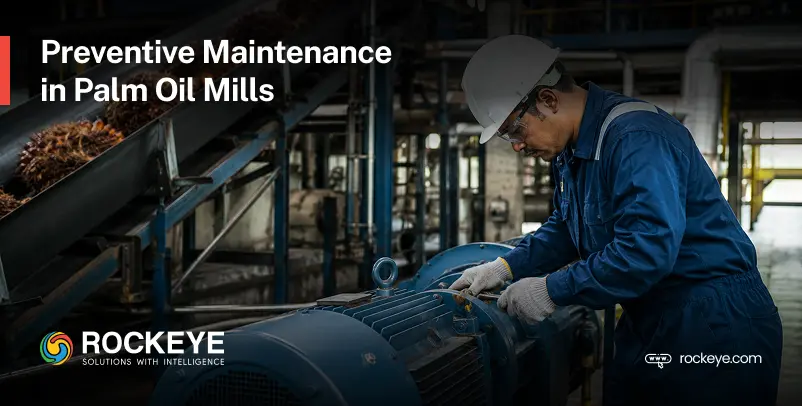


Every minute of unexpected downtime in a palm oil mill comes at a cost. Whether it’s a sterilizer failure, conveyor breakdown, digester issue, or clarification system malfunction, production delays quickly translate into lost revenue, missed delivery schedules, increased maintenance expenses, and frustrated operations teams.
For mill operators across Indonesia and Malaysia, the challenge isn’t simply fixing equipment faster; it’s preventing failures before they happen. That’s why leading mills are moving away from reactive maintenance and adopting palm oil mill maintenance software integrated with ERP to gain complete visibility over assets, work orders, spare parts, and maintenance schedules.
As production targets continue to increase and sustainability standards become more stringent, preventive maintenance is no longer a “nice-to-have.” It has become a competitive advantage that helps mills improve equipment reliability, maximize throughput, and make better operational decisions.
In this article, we’ll explore how preventive maintenance supported by a modern CMMS (Computerized Maintenance Management System) helps palm oil mills reduce downtime, improve operational efficiency, and achieve higher profitability.

Why Preventive Maintenance Matters More Than Ever
Palm oil processing depends on dozens of interconnected machines working in perfect coordination. A failure in one critical asset often creates a domino effect across the entire production line.
Common maintenance challenges include:
- Unexpected equipment breakdowns
- Poor visibility into machine health
- Missed preventive maintenance schedules
- Spare parts shortages
- Manual maintenance records
- Delayed work order approvals
- Lack of maintenance KPIs
These issues become even more significant for multi-mill operations spread across Indonesia and Malaysia, where centralized visibility is essential for operational excellence.
What Is Preventive Maintenance?
Preventive maintenance is a planned approach where maintenance activities are performed before equipment fails. Instead of waiting for a breakdown, maintenance teams inspect, lubricate, replace wear parts, and service machinery according to:
- Operating hours
- Production cycles
- Calendar schedules
- Equipment condition
- Manufacturer recommendations
The objective is simple: “Prevent failures instead of reacting to them.”
This strategy extends equipment life, improves production stability, and significantly reduces emergency maintenance costs.
Don’t Miss: How Predictive Maintenance Reduces Fuel Station Downtime and Improves Asset Uptime
How Palm Oil Mill Maintenance Software Transforms Maintenance Operations
Traditional maintenance relies heavily on spreadsheets, paper checklists, phone calls, and operator experience. Modern maintenance software changes everything.
A CMMS integrated into an ERP platform creates a single source of truth for maintenance teams, plant managers, and operations leaders. Key capabilities include:
1. Automated Preventive Maintenance Scheduling
The system automatically generates maintenance work orders based on:
- Running Hours
- Machine Utilization
- Calendar Frequency
- Production Batches
- Maintenance History
This eliminates forgotten inspections and overdue servicing.
2. Digital Work Order Management
Technicians receive work orders digitally with:
- Priority Level
- Equipment Location
- Maintenance Checklist
- Required Spare Parts
- Safety Instructions
- Completion Deadlines
Managers gain complete visibility into ongoing maintenance activities.
3. Asset Performance Monitoring
Every maintenance activity builds a complete equipment history. This helps identify:
- Frequently Failing Machines
- High-cost Assets
- Recurring Issues
- Maintenance Trends
- Mean Time Between Failures (MTBF)
- Mean Time To Repair (MTTR)
These insights enable smarter maintenance planning.
4. Spare Parts Inventory Control
One of the biggest causes of extended downtime is unavailable spare parts. An integrated CMMS automatically:
- Tracks Inventory Levels
- Issues Reorder Alerts
- Maintains Purchase History
- Prevents Stockouts
This ensures maintenance teams have the right parts when needed.
Benefits of Using Preventive Maintenance in Palm Oil Mills
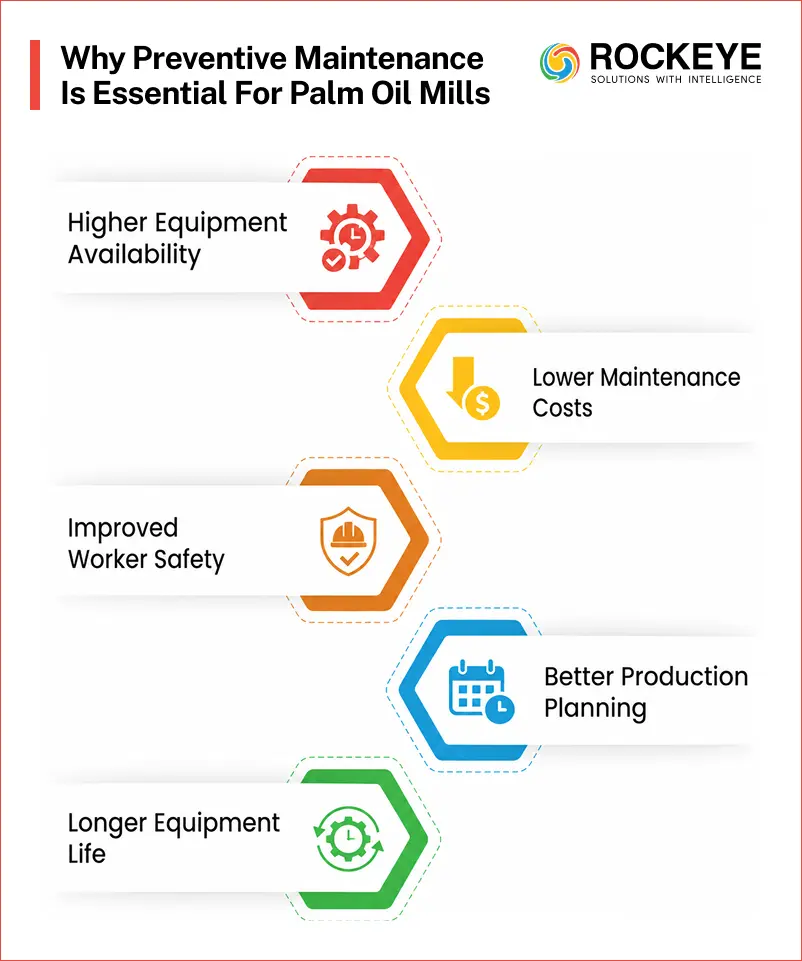
Preventive maintenance delivers measurable operational improvements
1. Higher Equipment Availability
Regular servicing keeps critical assets operating at peak efficiency. This means:
- Fewer Breakdowns
- Less Production Interruption
- Higher Machine Uptime
2. Lower Maintenance Costs
Emergency repairs are significantly more expensive than planned maintenance. Preventive maintenance reduces:
- Overtime Labor
- Emergency Spare Purchases
- Equipment Replacement Costs
- Production Losses
3. Improved Worker Safety
Unexpected machine failures increase workplace risks. Routine inspections help detect:
- Loose Components
- Oil Leaks
- Electrical Faults
- Mechanical Wear
- Before they become safety incidents.
4. Better Production Planning
Operations teams can confidently schedule production when equipment reliability improves. This reduces uncertainty and supports more consistent throughput.
5. Longer Equipment Life
Routine servicing reduces excessive wear on expensive assets such as:
- Sterilizers
- Boilers
- Digesters
- Presses
- Clarification Systems
- Turbines
- Conveyors
- Extending asset life delays costly capital investments.
Why ERP Integration Makes CMMS Even More Powerful
Many maintenance systems operate independently from production and finance. That creates information silos. With our ERP platform for palm oil, maintenance becomes connected with every critical business function.
Maintenance teams can instantly access:
- Equipment Costs
- Inventory Availability
- Procurement Status
- Purchase Requests
- Production Schedules
- Vendor Information
- Budget Tracking
Instead of isolated maintenance records, managers receive complete operational intelligence.
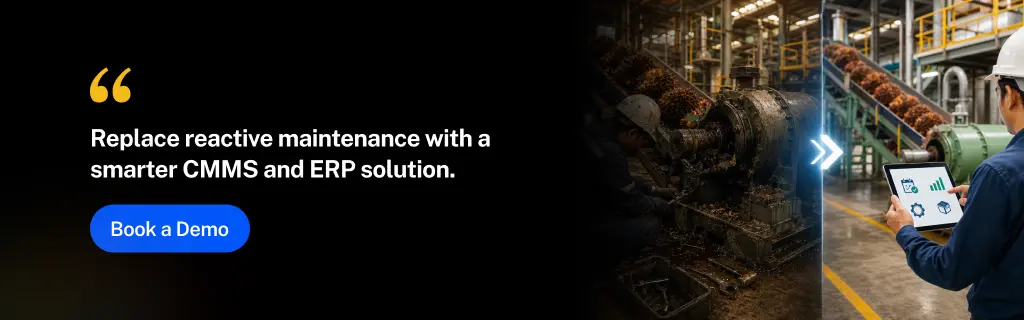
From Reactive Maintenance to Predictive Operations
The most successful palm oil mills are moving beyond preventive maintenance toward predictive maintenance. By combining historical maintenance data with real-time operational information, mills can identify warning signs before failures occur.
Examples include:
- Rising Vibration Levels
- Increasing Motor Temperature
- Repeated Work Orders
- Excessive Lubrication Frequency
- Declining Equipment Efficiency
- Maintenance teams can then intervene before production is affected.
Research published in 2026 on palm oil processing equipment also reinforces that critical machinery such as threshers requires structured maintenance practices to sustain continuous operations and production efficiency.
Why Digital Transformation Is Accelerating Across Indonesia and Malaysia
The palm oil industry is becoming increasingly data-driven. Mill operators face growing pressure to improve:
- Productivity
- Traceability
- Sustainability
- Operational Efficiency
- Cost Control
Industry-wide digital initiatives are also gaining momentum. In Malaysia, MPOB has expanded digital platforms such as SIMS and GeoSAWIT to improve transparency, monitoring, and supply chain visibility across the palm oil ecosystem.
Maintenance is naturally becoming part of this broader digital transformation. Forward-looking organizations are replacing manual maintenance processes with integrated digital platforms that support faster decision-making across multiple mills.
How ROCKEYE’s ERP for Palm Oil Operations Supports Preventive Maintenance
ROCKEYE’s ERP for palm oil operations combines enterprise resource planning with a powerful CMMS to help mills operate more efficiently. The platform enables organizations to:
- Digitize Maintenance Workflows
- Schedule Preventive Maintenance Automatically
- Track Asset Performance
- Manage Spare Parts Inventory
- Monitor Maintenance KPIs
- Integrate Procurement and Maintenance
- Improve Operational Visibility Across Multiple Mills
Rather than using disconnected systems, decision-makers gain one centralized platform for maintenance and operations management. For Mill General Managers, Plant Managers, COOs, IT Managers, and Group Operations Directors, this creates better visibility, stronger accountability, and more informed decisions.
Must Read: What is Palm Oil ERP Software? A Complete Guide for Mills & Refineries
Choosing the Right Maintenance Software
Before selecting a maintenance solution, ask these questions:
- Does the maintenance solution support multi-mill operations?
Large organizations require centralized visibility across multiple facilities.
- Is the maintenance solution integrated with ERP?
Maintenance should connect seamlessly with inventory, purchasing, finance, and production.
- Can the maintenance software automate preventive maintenance?
Manual scheduling increases the risk of missed maintenance activities.
- Does it provide real-time dashboards?
Executives need instant access to maintenance KPIs and asset performance.
- Is the maintenance ERP software scalable?
The software should grow alongside your operations.
Conclusion
As palm oil mills across Indonesia and Malaysia continue their digital transformation journey, preventive maintenance is becoming a strategic business function rather than simply a maintenance activity.
By replacing reactive repairs with planned maintenance supported by palm oil mill maintenance software, mills can significantly reduce downtime, extend equipment life, improve production efficiency, and lower maintenance costs.
When maintenance is integrated with our ERP platform for palm oil, organizations gain complete visibility across maintenance, procurement, inventory, finance, and production, enabling faster decisions and stronger operational performance.
If your goal is to maximize mill uptime, improve operational efficiency, and build a smarter maintenance strategy, investing in modern palm oil mill maintenance software is no longer optional; it’s a critical step toward achieving sustainable growth and operational excellence.
Frequently Asked Questions
What features should the best palm oil mill maintenance software include?
When evaluating a maintenance solution, look for features such as
- Preventive maintenance scheduling
- Digital work orders
- Asset lifecycle management
- Mobile maintenance app
- Spare parts inventory management
- Maintenance dashboards
- MTBF and MTTR reporting
- Multi-mill management
- ERP integration
- Role-based approvals
- Audit trails
- AI-powered maintenance recommendations
These capabilities help mills improve operational efficiency while supporting long-term digital transformation.
Is preventive maintenance worth the investment for palm oil mills?
Absolutely. Although preventive maintenance requires upfront planning and investment, it typically delivers measurable operational benefits by
- Reducing unexpected downtime
- Extending equipment life
- Lowering emergency repair costs
- Improving worker safety
- Increasing production reliability
- Optimizing spare parts inventory
- Supporting sustainability and compliance initiatives
Modern preventive maintenance software integrated with ERP also provides a centralized view of maintenance, procurement, inventory, and production, enabling managers to make faster and more informed operational decisions.
Can AI improve maintenance in palm oil mills?
Yes. Artificial intelligence in palm oil mills is becoming a major driver of maintenance optimization. AI can help maintenance teams:
- Predict equipment failures
- Analyze vibration and temperature trends
- Recommend maintenance schedules
- Optimize spare parts inventory
- Detect recurring equipment issues
- Prioritize work orders
- Forecast maintenance costs
Instead of reacting to failures, mills can make proactive maintenance decisions that improve uptime and reduce operational costs. AI copilots, voice-enabled work orders, and condition-based maintenance are among the fastest-growing CMMS capabilities.
What is the difference between preventive maintenance and predictive maintenance?
Preventive maintenance follows predefined schedules based on time, production hours, or operating cycles. Predictive maintenance uses real-time equipment data such as vibration, temperature, pressure, and historical failure patterns to determine exactly when maintenance is needed.
Many leading palm oil mills begin with preventive maintenance and gradually adopt predictive maintenance using IoT sensors, AI analytics, and integrated ERP systems. AI-enabled CMMS platforms increasingly combine these approaches to improve asset reliability and reduce unnecessary maintenance.
What are the biggest causes of unplanned downtime in palm oil mills?
Most unplanned downtime is caused by maintenance-related issues rather than production planning. Common causes include:
- Delayed preventive maintenance
- Equipment wear and tear
- Lubrication failures
- Bearing damage
- Motor overheating
- Boiler issues
- Spare parts shortages
- Manual maintenance tracking
- Slow work order approvals
Using digital maintenance software significantly improves visibility into these issues before they become production stoppages.
How does a CMMS reduce downtime in a palm oil mill?
A Computerized Maintenance Management System (CMMS) reduces downtime by ensuring maintenance activities happen before equipment fails. Instead of relying on manual spreadsheets or paper checklists, a CMMS automatically:
- Creates preventive maintenance schedules
- Generates work orders
- Tracks maintenance history
- Monitors spare parts inventory
- Sends maintenance reminders
- Prioritizes critical repairs
When integrated with ERP, maintenance teams also gain visibility into production schedules and procurement, making maintenance planning far more efficient.
What is the best maintenance strategy for a palm oil mill?
The most effective maintenance strategy combines preventive maintenance, condition-based monitoring, and predictive maintenance within an integrated ERP and CMMS platform.
Reactive maintenance may appear less expensive initially, but frequent equipment failures often lead to higher repair costs, lower production output, emergency spare-part purchases, and extended downtime.
A modern maintenance strategy should include:
- Automated preventive maintenance schedules
- Digital work orders
- Equipment health monitoring
- Spare parts inventory management
- Maintenance KPIs like MTTR and MTBF
- ERP integration for procurement and production planning
This approach enables mills to reduce downtime while extending the lifespan of critical assets such as sterilizers, boilers, presses, digesters, turbines, and conveyors.