


For palm oil executive teams across North Sumatra or Selangor, the morning routine looks identical: tracking Rotterdam CIF prices, cross-checking mill dispatch logs, and hoping the margin calculated on a spreadsheet matches reality. In an era of aggressive mandates and tightening international rules, hoping is no longer a viable business strategy.
When your sales data is separated from logistics by a 24-hour reporting delay, you aren’t just managing a business; you are leaking money on every metric ton of Crude Palm Oil (CPO) shipped.
To thrive in today’s volatile marketplace, shifting from defensive cost-cutting to offensive margin optimization is essential. Deploying specialized palm oil sales and distribution software addresses these challenges, turning hidden supply chain blind spots into predictable profitability.
The Hard Truth of Palm Oil Logistics
The Southeast Asian palm oil supply chain is uniquely unforgiving. Unlike static manufacturing setups, palm oil deals with a highly perishable biological asset that fluctuates in grade, weight, and value at every single touchpoint. Midstream traders and integrated plantation firms operate within razor-thin windows where structural inefficiencies quickly erode paper margins.
Several key operational challenges regularly undermine standard B2B sales cycles:
- Fragmented Mill and Plantation Data: Yield metrics from estates rarely match up with real-time mill reception logs. When sales teams lack visibility into actual storage tank levels, they write contracts based on historical averages rather than real-time supply, resulting in over-commitments or costly emergency spot-market purchases.
- The Logistical Black Box: The moment a tanker truck leaves the mill gate headed for an ocean port terminal like Dumai or Port Klang, operational visibility drops. Delays at dispatch checkpoints, unmonitored transit times, and lack of temperature controls directly degrade product quality, impacting Free Fatty Acid (FFA) targets and inviting severe buyer penalties.
- Volatile Order Adjustments: CPO trading moves fast. When a major buyer changes an order volume or shifts delivery destinations mid-transit, manual tracking systems often buckle under the pressure. The lack of a unified palm oil order management system means manual renegotiations are handled via frantic WhatsApp strings and disconnected emails, which causes delayed invoicing and creates opportunities for billing errors.
- Escalating Compliance Overheads: Global supply chains face unprecedented regulatory scrutiny. Traders must prove deep traceability for every shipment down to the specific GPS coordinates of the fresh fruit bunch (FFB) harvest. Manually compiling this data requires significant labor and often delays contract clearances, exposing traders to localized market price drops.
Must Read: What is Palm Oil ERP Software? A Complete Guide for Mills & Refineries
2026 Market Analysis: Navigating High Strains and Volatility
Operating a trading desk in today’s market requires deep insight into structural shifts across Indonesia and Malaysia. The current commercial environment presents tight supply baselines coupled with aggressive domestic consumption policies.
Indonesia’s Local Demand Shock
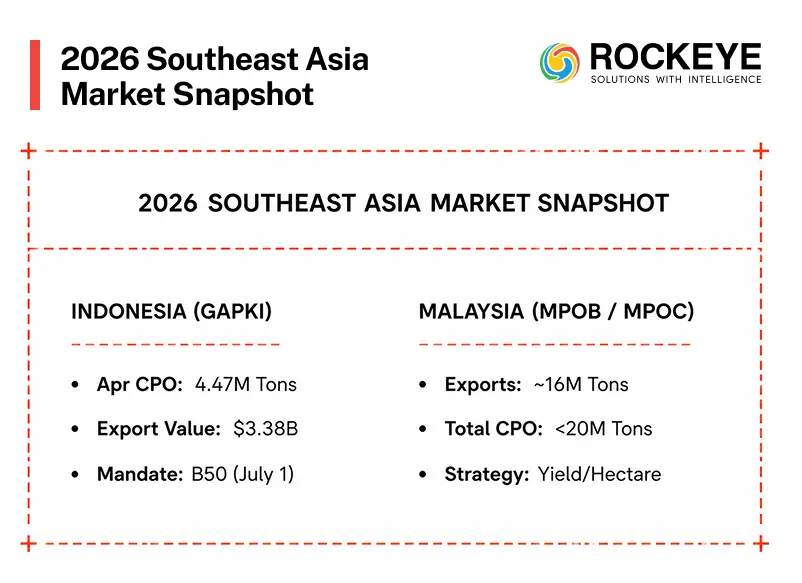
According to data from the Indonesian Palm Oil Association (GAPKI), April 2026 CPO production reached 4.479 million tons, with monthly export values rising significantly to $3.38 billion.
The defining market event is Indonesia’s formal implementation of the B50 biodiesel mandate, officially launched by President Prabowo Subianto. This regulatory shift requires diesel fuel to contain 50% palm oil-based biodiesel, moving up from the prior B40 blend.
GAPKI and Ministry data indicate this policy will absorb an additional 3.5 million tons of CPO annually into domestic biorefineries. This domestic demand cushion insulates local growers but significantly tightens the volume available for global buyers, driving the average price to around $1,408 per ton CIF Rotterdam.
Malaysia’s Production Ceiling
Concurrently, the Malaysian Palm Oil Board (MPOB) and MPOC market outlook reports indicate that Malaysia’s full-year palm oil exports are projected to reach up to 16 million tons, supported by a drawdown of domestic stock levels.
Total national production is expected to stay slightly below 20 million tons due to aging tree profiles and strict land-use limits. Rather than relying on physical estate expansion, Malaysian operators must focus heavily on maximizing the value of every hectare harvested.
The Margin Impact
With tight supplies and rising prices, execution errors become incredibly costly. If a trader locks in an export contract but experiences local logistics delays, the penalty fees and replacement costs will instantly wipe out the projected profit margin. Relying on slow, disconnected tracking systems makes it impossible to manage these fast-moving risks effectively.
Interesting Read: Why Palm Oil Companies in Malaysia Are Moving to Cloud-based System in 2026
Why Traditional Systems Fail Midstream Traders
Most palm oil operators rely on legacy ERP platforms or generalized, multi-industry accounting tools. While these applications process standard transactions well, they are not built to handle the unique, fast-moving complexities of agricultural commodity trading.
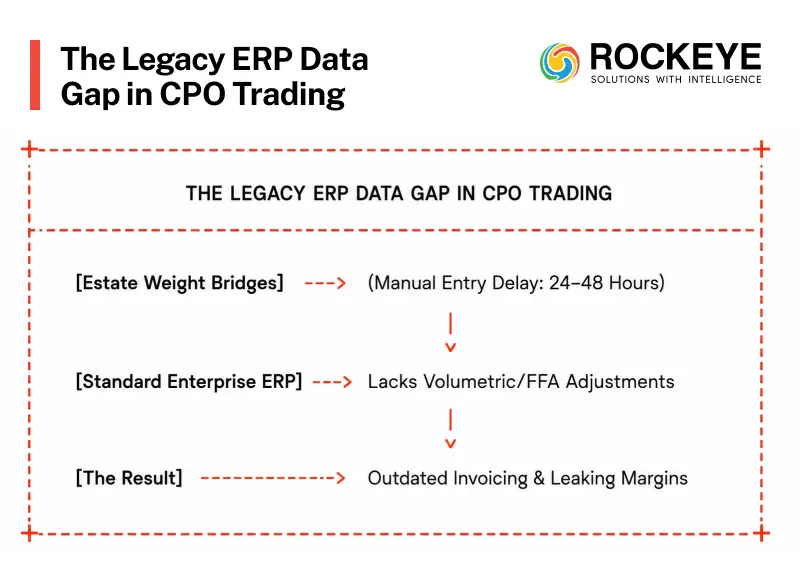
Legacy software typically treats inventory as fixed, discrete units like boxes in a warehouse. However, CPO is a dynamic liquid. Its volume expands or contracts based on temperature, and its quality profile changes over time.
If your core operating platform cannot automatically recalculate bulk prices based on changing FFA levels or moisture variations recorded at the port terminal, your finance team must reconcile those adjustments manually. This leads to long processing delays, delayed invoicing, and cash flow blockages.
Furthermore, generic business software lacks native tools for managing transport logistics, dispatch tracking, and regulatory export compliance. When sales desks work in isolation from estate realities, they operate with major blind spots, leaving them highly vulnerable to sudden market shifts and unexpected supply shortfalls.
Embracing Modern Supply Chain Intelligence
Navigating these challenges requires moving away from reactive, manual workflows and adopting integrated digital solutions that provide full visibility across operations.
Transitioning to a dedicated palm oil operational intelligence platform enables businesses to:
- Gain Real-Time Operational Visibility: Connect plantation harvest projections directly with mill output and port storage levels to make highly accurate commercial commitments.
- Automate Order Optimization: Use integrated tools to match active contracts with the most efficient logistical routes and available storage capacity, cutting down transit times and lowering fuel costs.
- Streamline Regulatory Compliance: Gather and organize verified data across the entire supply chain to easily meet strict sustainability rules, keeping high-value international markets open and accessible.
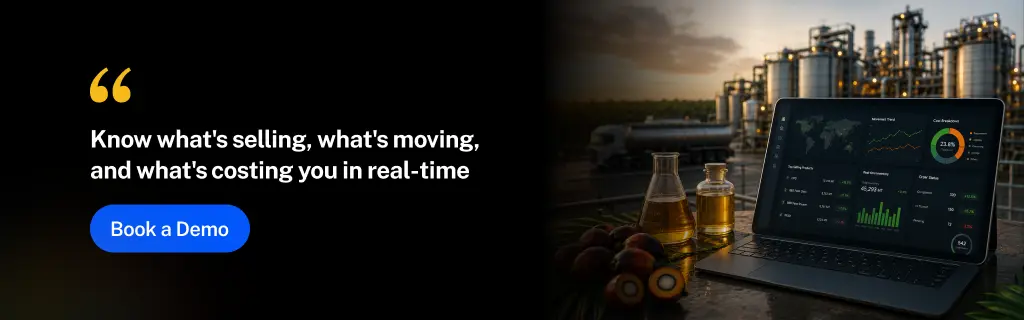
Enhancing Operational Efficiency with ROCKEY
Designed specifically to meet the unique challenges of the agricultural commodity sector, ROCKEYE bridges the gap between complex fieldwork and fast-paced trading environments. The platform provides direct operational control by linking every phase of the palm oil supply chain into a single, intuitive system.
Rather than forcing teams to piece together data from different applications, ROCKEYE provides a unified digital environment tailored specifically for palm oil operations:
- Integrated Logistics Control: Track shipments in real time from the mill scale houses all the way to ocean port terminals, helping teams spot and resolve shipping delays before they lead to contract penalties.
- Dynamic Order Management: Automatically update and adjust open orders based on incoming quality metrics, ensuring billing is always accurate and eliminating manual paperwork.
- Proactive Operational Planning: Provide sales teams with instant access to current inventory levels across all storage facilities, allowing them to confidently capture high-margin spot market opportunities.
By replacing disconnected legacy tools with a unified platform, palm oil companies can significantly cut down operational friction, protect their trading margins, and build a highly responsive, resilient supply chain.
Explore ROCKEYE’s specialized modules by visiting the dedicated digital platform for palm oil.
Before vs. After: Deploying Specialized Palm Oil Software
| Operational Area | Before ROCKEYE (Legacy Systems) | After ROCKEYE (Modern Digital Platform) |
| Contract Execution | Sales desks sell volumes based on outdated morning reports, risking unexpected stock shortages. | Instant access to live bulk inventory data allows teams to maximize profitable spot market sales. |
| Quality Risk Management | FFA and moisture downgrades are discovered late at the port, leading to steep price discounts. | Automated quality tracking flags potential product degradation early, letting teams redirect shipments efficiently. |
| Logistics Coordination | Transport delays and demurrage costs are tracked manually via chat apps and spreadsheets | Live transit tracking highlights delays at checkpoints early, protecting operations from high port fees. |
| Regulatory Compliance | Compliance teams spend weeks manually gathering paper trail documents to prove product origin. | Digital verification maps batches to their exact source, generating export-ready compliance reports instantly. |
Conclusion
The palm oil industry is entering a new era where operational visibility, data accuracy, and faster decision-making directly impact profitability. For companies across Indonesia and Malaysia, managing plantations, mills, sales, and distribution through disconnected systems creates unnecessary cost and margin pressure.
Digital platforms such as palm oil sales and distribution software help businesses move from reactive operations to proactive management. By connecting supply chain intelligence, ESG readiness, and commercial performance insights, palm oil leaders can make smarter decisions, improve efficiency, and build a more resilient business prepared for the future.
Frequently Asked Questions
1. What is digital transformation in the palm oil industry?
Digital transformation in the palm oil industry is the use of digital technologies, connected software, AI, and real-time data to improve plantation management, mill operations, sales, logistics, and supply chain decision-making. Instead of relying on spreadsheets or disconnected systems, companies gain end-to-end visibility across operations. This helps reduce delays, improve productivity, strengthen traceability, and support ESG compliance while making faster commercial decisions.
2. How is AI used in palm oil plantations?
AI is used in palm oil plantations to analyze operational data, predict crop yields, optimize harvesting schedules, monitor plantation performance, and improve resource allocation. It can also identify operational inefficiencies, support preventive maintenance, forecast demand, and provide real-time insights that help plantation managers make faster and more informed decisions.
3. What are Indonesia’s palm oil export trends in 2026?
Latest industry estimates suggest Indonesia remains the world’s largest palm oil exporter, but export growth is increasingly influenced by domestic biodiesel demand under the B40 mandate and proposed B50 expansion. As more crude palm oil is allocated for domestic fuel production, exporters face tighter supply planning and greater pressure to optimize inventory, pricing, and customer commitments.
4. What are the biggest challenges facing Malaysia’s palm oil industry?
Malaysia’s palm oil industry faces several challenges, including labor shortages, fluctuating global commodity prices, stricter sustainability regulations, traceability requirements under the EU Deforestation Regulation (EUDR), and changing export demand. To remain competitive, many producers are investing in digital technologies that improve operational visibility, supply chain efficiency, and ESG reporting.
5. How can palm oil companies improve ESG compliance?
Palm oil companies can improve ESG compliance by digitizing operational records, strengthening traceability, monitoring plantation activities in real time, and maintaining accurate supply chain documentation. Digital platforms make it easier to demonstrate responsible sourcing, generate compliance reports, and meet evolving regulatory requirements such as the EU Deforestation Regulation (EUDR) and national sustainability certification standards.
6. What is a plantation visibility system?
A plantation visibility system is a digital platform that provides real-time insights into plantation operations, including harvesting, field activities, labor productivity, inventory, and logistics. By connecting operational data from multiple locations, it helps managers identify issues earlier, improve resource utilization, and make faster operational decisions.
7. How does AI reduce operational costs in palm oil mills?
AI reduces operational costs in palm oil mills by identifying production bottlenecks, predicting equipment maintenance needs, optimizing processing efficiency, and improving production planning. By turning operational data into actionable insights, AI helps reduce downtime, minimize waste, improve resource utilization, and support higher profitability.
8. What is palm oil sales and distribution software?
Palm oil sales and distribution software is a business platform that helps producers, traders, and distributors manage customer orders, inventory, pricing, deliveries, invoicing, and sales performance from a single system. It improves operational visibility, reduces manual work, and enables faster decision-making across the commercial supply chain.
9. Why do palm oil companies need CPO trading software?
CPO trading software helps palm oil businesses manage contracts, customer orders, inventory, pricing, logistics, and trade documentation more efficiently. By providing real-time commercial visibility, it enables companies to reduce manual errors, respond faster to market changes, and improve trading margins while supporting better coordination between sales, operations, and finance.
10. How can digital platforms improve CPO trading margins?
Digital platforms improve CPO trading margins by giving companies real-time visibility into inventory, production, customer demand, and logistics. With faster access to accurate information, businesses can reduce order delays, optimize pricing decisions, lower operational costs, and respond more effectively to market volatility. The result is better profitability, improved customer service, and stronger supply chain performance.